Firecrawl Alternatives: 6 Web Data Tools for AI Agents and Pipelines in 2026
TL;DR: Firecrawl is a strong web data API that turns pages into clean, LLM-ready markdown, with a free plan of 1,000 credits a month. If what you want is typed records from many platforms instead of page text, pick Anysite. Crawl4AI is the open-source crawler you host yourself. ScrapingBee is a proxy-heavy scraping API for pages that block you. Apify is a marketplace of ready-made Actors. Tavily is a search API built for agents. Jina Reader is the plainest way to turn one URL into markdown.
We read each vendor's own site on October 15, 2026 for every price and feature quoted here.
The short list
| Alternative | Built around | Entry price (Oct 2026) | Best for |
|---|---|---|---|
| Anysite | Typed JSON per source, 900+ sources, plus a web parser | $30/month (MCP), $49/month (API) | Agents and pipelines that need records, not pages |
| Crawl4AI | Open-source crawler, markdown and schema extraction | Free (self-hosted); Cloud from $10 | Teams that want to run the crawler themselves |
| ScrapingBee | Scraping API with proxies and JS rendering | $19/month | Pages that block plain requests |
| Apify | Marketplace of 87,000+ Actors on a compute platform | $0 with $5 usage; Starter $19/month | Ready-made scrapers for specific sites |
| Tavily | Search, extract, crawl and map API for agents | Free 1,000 credits; Project $30/month | Search-first research agents |
| Jina Reader | URL-to-markdown and search over a token balance | Free without a key; $50 for 1B tokens | One-off pages and cheap grounding |
For reference, Firecrawl costs $0 for 1,000 credits a month, then $19 a month on Hobby billed monthly, as of October 2026.
What Firecrawl does well
Firecrawl calls itself the "Web Data API for AI Agents". Its pitch is short: search and scrape the web, and get back data an LLM can read. It delivers on that. In our own test, July 7–8, 2026, Firecrawl produced the cleanest markdown of the three tools we measured. That output goes straight into a prompt with little cleanup.
The product has grown well past one scrape endpoint. Scrape, Crawl, Map, Search, Interact and Monitor all draw from one credit balance. A basic scrape, crawl or map costs 1 credit per page. Search costs 2 credits per 10 results. Structured JSON output adds 4 credits per page. The pricing is easy to reason about.
The free plan is real. You get 1,000 credits every month, refreshed monthly, with no card. A scrape that returns no result is not charged. Paid plans add pay-as-you-go top-ups in $5 steps, capped by a monthly limit you set.
Firecrawl is also open source under AGPL-3.0, with 191.6K GitHub stars on its repository. The company says it is "Trusted by 150,000+ companies". Compliance buyers get SOC 2 Type II. That track record matters when you pick a dependency for production. For a head-to-head with Apify, including our own speed test, see Apify vs Firecrawl.
Why people look for Firecrawl alternatives
Four reasons come up most.
- They need records, not pages. Markdown is still text. An agent that wants a company's headcount or a post's engagement must parse it out, and redo that work when the page changes.
- Licence and hosting. The open-source edition is AGPL-3.0. The README says the cloud version "includes additional features". Teams that want a permissive licence look at Crawl4AI.
- Credit math at volume. Hobby, Standard and Growth credits do not roll over. JSON extraction multiplies the per-page cost by five. Bills grow with every page.
- Freshness and blocked pages. In our own test, July 7–8, 2026, Firecrawl's
/v2/scrapeserved cached results by default; we setmaxAge: 0to get fresh pages. Teams that need live data or heavily protected sites compare other options.
How we picked these alternatives
Every tool here passes three bars. It returns web content to code or an agent through an API. It is on sale today with a public price. It has a free plan, a free allowance or a trial.
We left out pure proxy networks and headless-browser hosting. They solve a lower layer of the problem, and you still write the extraction yourself.
Anysite is our product. It sits first as the pick for teams whose agents or pipelines need typed records from many platforms, not page text. The rest follow from the closest like-for-like swap to the plainest tool.
1. Anysite: typed data from 900+ sources, with a parser for the rest
Anysite is a live web data layer for agents and pipelines. It covers 900+ sources and 5,000+ endpoints (anysite.io, October 2026). For a known platform, you call an endpoint and get typed JSON back. For any other URL, a web parser returns the cleaned page. Data is "pulled live from the source at the moment you ask — not served from a warehouse snapshot."
- Typed fields instead of page text. Endpoints return people, companies, posts and prices as structured records. There is nothing to parse.
- Broad source coverage. Social media, developer platforms, business intelligence, marketplaces, and local and maps data. B2B people and company data has 30+ endpoints, including search, jobs and an email finder.
- A web parser for any URL.
POST /api/webparser/parsereturns title, main content, author, date, metadata, links and images. It strips navigation and ads, and handles JavaScript-rendered pages. - Four interfaces, one engine. CLI, MCP, REST API and n8n share one engine. The MCP server works with Claude, Cursor, Codex, Gemini CLI and any MCP-compatible client.
- An open-source CLI for pipelines. The CLI is MIT-licensed. It runs YAML pipelines with cron scheduling and a
--dry-runcost preview, and loads into SQLite, PostgreSQL, ClickHouse or Parquet. - Fast on fresh pages in our test. In our own test, July 7–8, 2026, the web parser returned each of four pages in 2.0–2.3 seconds. Firecrawl took 3.2–5.5 seconds on the same pages with caching off. That was two runs on four pages, so treat it as a signal, not proof.
Pricing (October 2026): two lines on the pricing page. The MCP line is flat: MCP $30 a month, MCP x5 $99, MCP x15 $199, all with every source and tool. The API line uses credits: Starter $49 a month for 15K credits, Growth $200 for 100K, Scale $300 for 190K, Pro $549 for 425K, Enterprise $1,199 for 1.2M. A standard request, including the web parser on any URL, costs 1 credit. Both lines start with a 7-day free trial; the API trial includes 1,000 credits.
How it differs from Firecrawl: Firecrawl hands you a page as text; Anysite returns the fields inside it, from platforms Firecrawl reads only as pages. Firecrawl's markdown is cleaner, and our own test said so. Anysite has no free plan: the trial needs a card to start. And on sites with aggressive bot defenses, results may vary, which is the honest limit of any-URL extraction.
Pick it if your agent needs structured records from many platforms and you would rather not maintain parsers.
2. Crawl4AI: the open-source crawler you host yourself
Crawl4AI calls itself an "open-source web crawler and scraper for LLMs and AI agents". It turns sites into "clean, LLM-ready Markdown" for RAG, agents and data pipelines. It is licensed under Apache 2.0 and shows 85.6k GitHub stars. The latest release is v0.9.5, dated October 14, 2026.
The feature set mirrors Firecrawl's core. "Clean Markdown" keeps headings, lists, tables and code blocks. "Fit Markdown" filters out menus, footers and boilerplate. LLM extraction works with any provider into a typed JSON schema, and CSS or XPath extraction works without an LLM. It drives Chromium, Firefox and WebKit, with persistent profiles, sessions and proxies. It runs as a self-hosted Docker server.
Pricing (October 2026): the library is free. Crawl4AI Cloud is pay as you go. Free use includes 2,000 credits to start, at 10 requests a minute and 2 at a time. Paid tiers start from $10, at 120 a minute and 10 at a time.
How it differs from Firecrawl: the licence is Apache 2.0 rather than AGPL-3.0, which suits teams that embed the crawler in their own product. You run the browsers, the proxies and the scaling yourself. Firecrawl's hosted service takes that work off your hands.
Pick it if you want Firecrawl-style markdown on your own infrastructure under a permissive licence.
3. ScrapingBee: a scraping API built to avoid blocks
ScrapingBee sells "the best web scraping API to avoid getting blocked". It handles proxies, headless browsers and anti-bot defenses for you. Recent additions bring it closer to Firecrawl. A Markdown Scraper turns "any page to clean Markdown or plain text, LLM-ready". AI extraction takes a field description and returns structured JSON. There is a Google search endpoint and an MCP server.
Pricing (October 2026): Hobby $19 a month for 75,000 API credits, Freelance $49 for 250,000, Startup $99 for 1,000,000, Business $249 for 3,000,000. Higher tiers run to $5,799 a month. Prices exclude VAT. The trial gives 1,000 free credits with no card. JavaScript rendering is on by default and costs 5 credits per request; without it, a request costs 1. Premium proxies cost 10 or 25 credits, stealth proxies 75. AI extraction adds 5 credits.
How it differs from Firecrawl: ScrapingBee gives you more control over proxies and rendering for hard sites. The flip side is credit math: a default JS-rendered request uses 5 credits, so Hobby covers about 15,000 such pages. Firecrawl charges 1 credit per page with no proxy tiers to plan around.
Pick it if your target pages block ordinary requests and you want proxy options in one API.
4. Apify: a marketplace of ready-made scrapers
Apify is a platform for running scrapers and automations, called Actors. Its Store calls itself "the largest marketplace of tools for AI" and lists 87,000+ Actors. For many popular sites, someone has already built and maintains one. You run it on Apify's compute and get a dataset back.
Pricing (October 2026): the Free plan is $0 with $5 of monthly usage and no card. Starter is $19 a month ($17 billed annually), Scale $199 ($179), Business $999 ($899). Each plan's fee is prepaid usage. Compute units cost $0.2 on Free and Starter, $0.16 on Scale and $0.13 on Business. Unused usage does not roll over. Many Store Actors also carry their own prices.
How it differs from Firecrawl: Apify wins on breadth. Its marketplace has thousands of specialized Actors, which our own July 2026 test also noted. The cost is variance: Actors differ in quality, price and speed. In that test, Apify's universal AI scraper took 27–101 seconds per page against Firecrawl's 3.2–5.5.
Pick it if a well-rated Actor already exists for the site you need, and you want to schedule it without code.
5. Tavily: search-first web access for agents
Tavily calls itself "the web access layer for AI agents" and says it is trusted by 3M+ developers. It starts from a query, not a URL. Search returns ranked results with content. Extract, Map and Crawl cover pages and sites once you know where to look.
Pricing (October 2026): Researcher is free with 1,000 API credits a month and no card. Project is $30 a month for 4,000 credits, Bootstrap $100 for 15,000, Startup $220 for 38,000, Growth $500 for 100,000. Pay as you go costs $0.008 per credit. A basic search costs 1 credit and an advanced search 2. Basic extraction costs 1 credit per 5 successful URLs. Map costs 1 credit per 10 pages.
How it differs from Firecrawl: Tavily is the stronger choice when the agent does not know the URL yet. Its search is the product, not an add-on. For bulk page conversion, Firecrawl's 1 credit per page on a 100,000-credit plan is the cheaper path.
Pick it if your agent answers questions from the open web and search quality matters more than page volume.
6. Jina Reader: the plainest URL-to-markdown
Jina Reader describes itself as "developer infrastructure: it converts a URL you supply into LLM-friendly text". You prepend r.jina.ai to a URL and get markdown back. Prepend s.jina.ai to a query and you get the top five results with their contents. It reads PDFs and can caption images. Jina's site now runs under Elastic, which also sells its commercial licences.
Pricing (October 2026): basic use is free without a key, at 20 requests a minute. Each new key comes with 10M free tokens for non-commercial use. Paid top-ups cost $50 for 1 billion tokens or $500 for 11 billion tokens on a premium key. Reader charges by tokens in the output; a search request starts from 10,000 tokens. Keys raise the Reader limit to 500 requests a minute, or 5,000 on premium.
How it differs from Firecrawl: Jina Reader is simpler and cheaper for occasional pages; there is no account to set up. It has no crawl jobs or monitors. The site also says Reader "does not actively circumvent or bypass" anti-bot systems, and it caches a URL for 5 minutes.
Pick it if you need markdown from a handful of URLs and want the lowest possible setup.
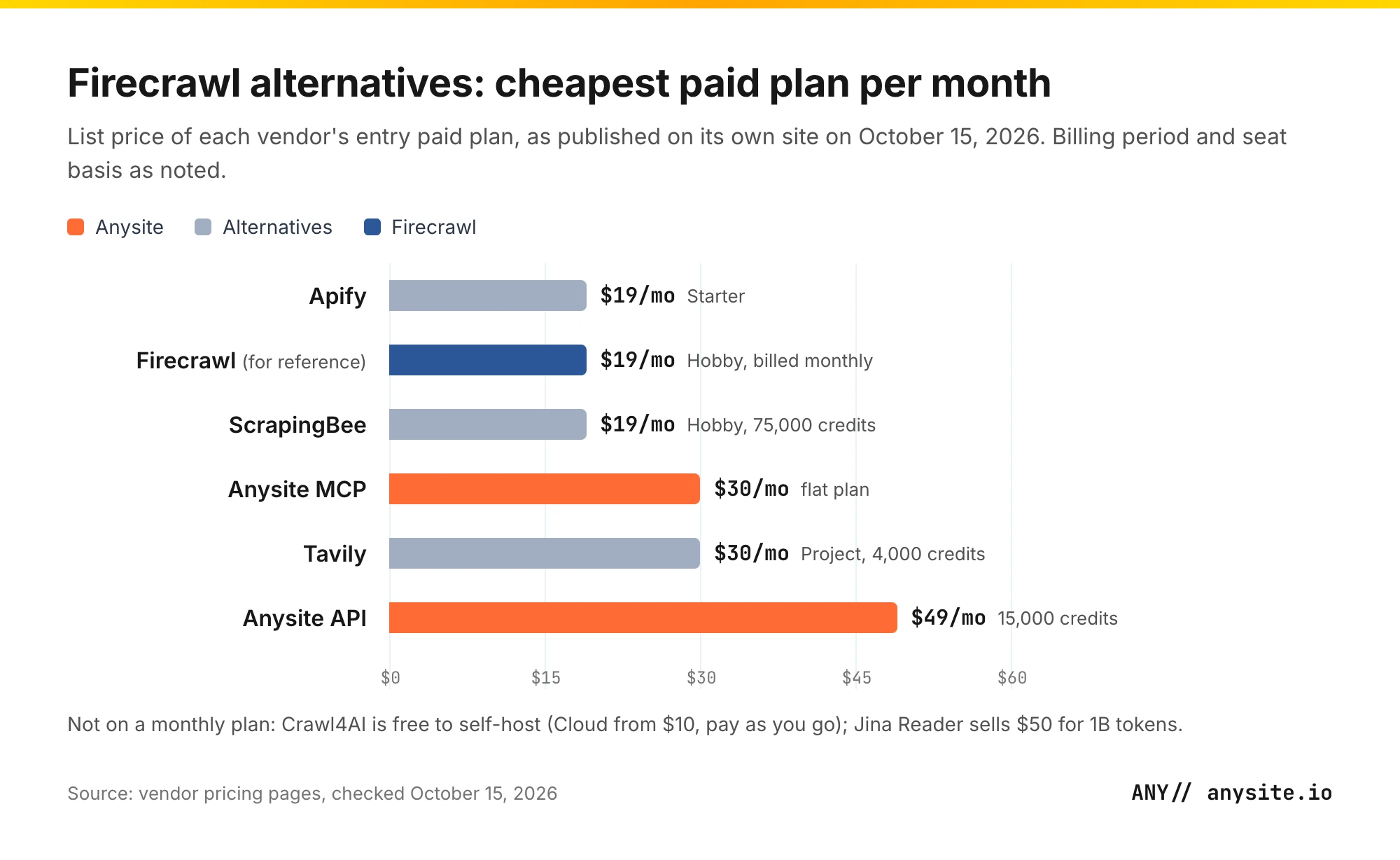
Firecrawl alternatives: pricing compared
| Tool | Pricing model | Entry price (Oct 2026) | Free or cheapest start |
|---|---|---|---|
| Anysite | Flat MCP plans; API credits per month | $30/month (MCP); $49/month (API, 15K credits) | 7-day free trial, card needed |
| Crawl4AI | Free library; Cloud pay as you go | $0 self-hosted; Cloud from $10 | 2,000 Cloud credits to start |
| ScrapingBee | Monthly API credits | $19/month (75,000 credits) | 1,000 free credits, no card |
| Apify | Prepaid platform usage plus Actor prices | $19/month (Starter) | Free plan with $5/month usage |
| Tavily | Monthly credits or pay as you go | $30/month (4,000 credits) | 1,000 free credits/month |
| Jina Reader | Prepaid token packages | $50 for 1B tokens | Free without a key; 10M tokens per new key (non-commercial) |
| Firecrawl (for reference) | Monthly credits plus pay-as-you-go top-ups | $19/month (Hobby, billed monthly) | 1,000 free credits/month, no card |
The entry price rarely tells you the full bill. Per-page tools grow with every page and every option. Firecrawl's JSON format turns 1 credit into 5. ScrapingBee's default rendering costs 5 credits, and stealth proxies 75. Tavily's advanced search doubles the cost. Apify adds Actor prices on top of compute. Anysite's API line meters credits too, and richer payloads cost more than a standard request. Its MCP line is flat, but it has limits: two rolling usage windows, one of 5 hours and one of 7 days. Hitting a limit returns a rate-limit error, and nothing is lost.
Which Firecrawl alternative should you choose?
Name the reason you're leaving, then match it.
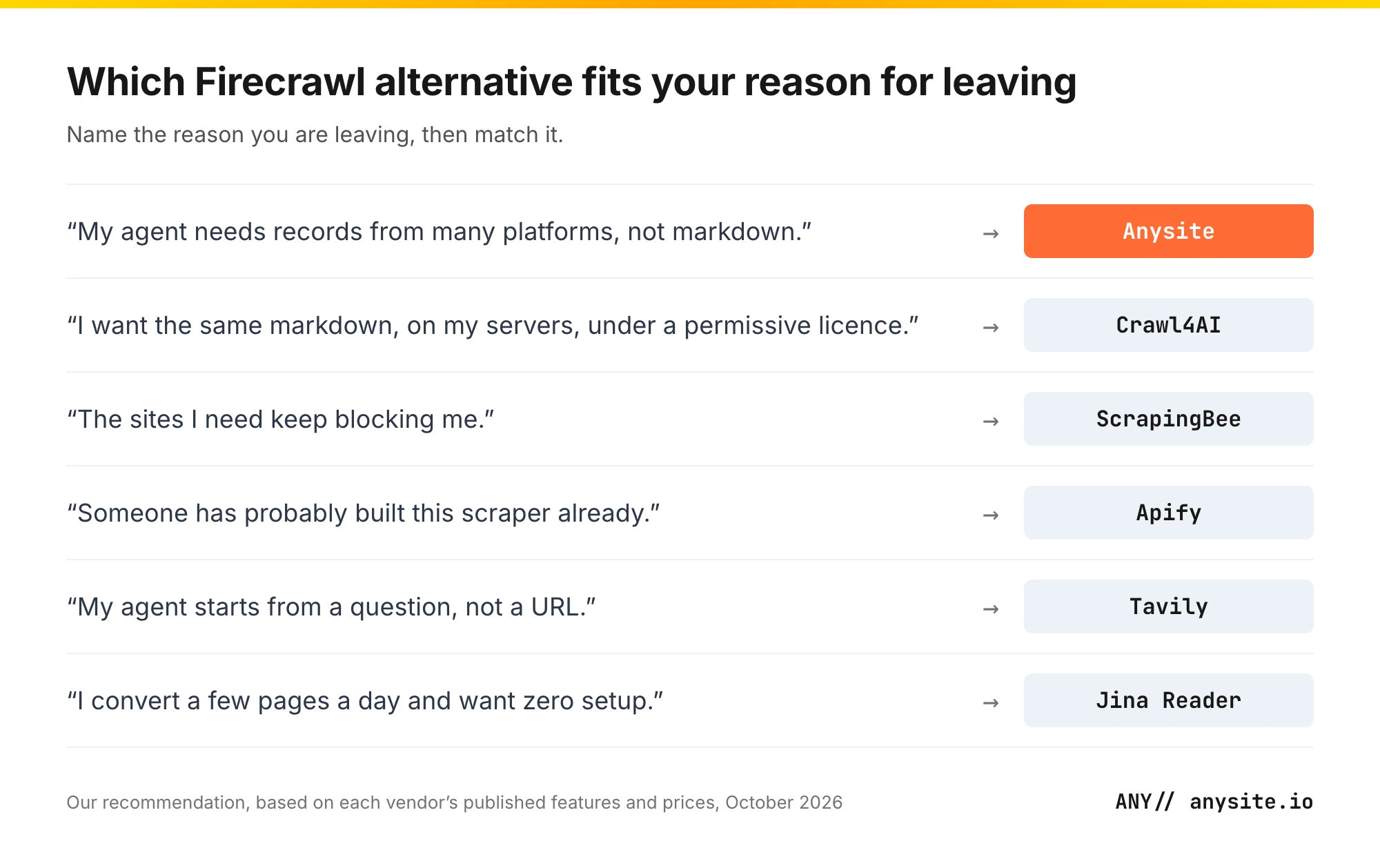
- "My agent needs records from many platforms, not markdown." Anysite.
- "I want the same markdown, on my servers, under a permissive licence." Crawl4AI.
- "The sites I need keep blocking me." ScrapingBee, for its proxy tiers.
- "Someone has probably built this scraper already." Apify, for its 87,000+ Actors.
- "My agent starts from a question, not a URL." Tavily.
- "I convert a few pages a day and want zero setup." Jina Reader.
You may not need to leave at all. If your job is turning pages into clean markdown for an LLM, Firecrawl does that very well. Its free plan covers 1,000 pages a month, and Standard covers 100,000 pages for $99 a month billed monthly, or $83 billed annually. Stay if markdown is the end product and your volume fits a plan.
Frequently asked questions
What is the best Firecrawl alternative?
It depends on why you are leaving. If your agents need typed records from many platforms rather than page text, Anysite is the closest fit. If you want an open-source crawler you run yourself, Crawl4AI is the like-for-like swap. For search-first agents, Tavily is built for that job.
How much does Firecrawl cost?
As of October 2026, Firecrawl has a free plan with 1,000 credits a month and no card. Hobby is $19 a month billed monthly or $16 billed annually for 5,000 credits. Standard is $99 a month billed monthly or $83 billed annually for 100,000 credits, Growth $399 or $333, and Scale $749 or $599. A basic scrape costs 1 credit per page.
Is there a free alternative to Firecrawl?
As of October 2026, Crawl4AI is free and open source under Apache 2.0 if you host it yourself. Jina Reader works without a key at 20 requests a minute, and new keys get 10M free tokens for non-commercial use. Tavily, ScrapingBee and Apify each have a free starting allowance.
Which Firecrawl alternative is best for a small team?
As of October 2026, a small team running one agent can start on Anysite's MCP plan at $30 a month, flat, with every source included. A team that only needs page text in small volumes can stay on free tiers: Jina Reader without a key, or Tavily's 1,000 free credits a month.
How is Anysite different from Firecrawl?
Firecrawl hands your agent a page as markdown, and you still parse it. Anysite returns typed fields such as people, companies, posts and prices from 900+ sources, plus a web parser for any other URL. Firecrawl's markdown is cleaner, and it has a free plan; Anysite starts with a 7-day trial that needs a card.
Keep reading
Apify alternatives
Marketplace scrapers, hosted crawlers and typed data APIs compared, with October 2026 prices.
ScrapingBee alternatives
Scraping APIs for blocked pages, side by side on credits, proxies and output.
Anysite MCP server
Connect Claude, Cursor or any MCP client to 900+ sources on one flat plan.
Try Anysite now
Give your agent typed data from 900+ sources, over MCP or API. The MCP and Starter plans start with a 7-day free trial.
anysite.io