Apify vs Firecrawl (vs Anysite): Which Web Data Tool Fits Your Job in 2026
Apify and Firecrawl both get web data into AI products, but they are built very differently. Firecrawl is one API that turns pages into clean markdown. Apify is a marketplace of 87,000+ ready-made tools, called Actors, plus the cloud that runs them. This page answers three questions. Which one fits your job? What does each cost at your volume? And when does a third option, Anysite, make more sense than either?
We read each vendor's own site on October 15, 2026 for every price and feature quoted here. Speed and output numbers come from our own test, July 7–8, 2026, which we also published as a separate benchmark post.
TL;DR Pick Firecrawl to turn arbitrary pages into LLM-ready markdown quickly, with a free plan and an open-source core. Pick Apify when a ready-made Actor already exists for your target site, or when you need a full platform to schedule and run custom crawlers. Pick Anysite if your agent or pipeline needs typed records, not page text, from many platforms over one API or MCP server.
What Firecrawl is
Firecrawl calls itself "the web data API to search and scrape" and "the infrastructure layer that helps AI find, read, and act on the live web." Its headline is "Give your AI agents web data and beyond."
The core is a small set of endpoints. Scrape returns markdown, JSON or screenshots. Crawl walks a site, Map lists its URLs, and Search returns results with full page content. Newer endpoints add Interact for clicking through pages, Monitor for watching changes, and Parse for documents. An Agent endpoint is in preview with five free runs a day.
Developer reach is a real strength. Firecrawl ships SDKs for Python, Node.js, Go, Rust, Java and Elixir, plus a CLI and an official MCP server. It says "over 1.25M developers" use it. The code is open source under AGPL-3.0, with a self-hosting guide in the repository. The cloud version adds features the self-hosted one lacks.
One detail matters for anything time-sensitive. Firecrawl serves cached pages by default: the maxAge setting defaults to 172,800,000 milliseconds, or two days. That makes repeat requests fast. If you need the live page, set maxAge: 0.
What Apify is
Apify describes itself as "a marketplace of ready-to-run tools for AI that automate work on the web." The Store lists "87,000+ ready-to-run tools called Actors." Each Actor targets a job, such as one site's search results, a store's product pages or a general crawl.
The platform around the Store is the other half. Apify runs Actors in its cloud, with scheduling, storage, proxies and integrations. You can build your own Actor with Crawlee, Apify's open-source crawling library. A hosted MCP server lets Claude, ChatGPT or Cursor find and run Actors.
For AI work, two Actors are the usual starting points. Website Content Crawler extracts text as markdown for LLMs and RAG pipelines. Its public record shows 168,484 users, and 96% of its runs in the last 30 days succeeded. AI Web Scraper is "an AI-first web scraper that extracts structured data from any website using natural-language prompts." Its Store page shows 9,922 users and "81.3% runs succeeded."
Breadth is Apify's clearest win. If someone has already built and maintained an Actor for your exact target, you skip the build entirely.
What each one costs to run
The three bill in different units. Firecrawl sells credits, Apify sells prepaid usage spent by Actors, and Anysite sells flat MCP plans or API credits.
Firecrawl (October 2026): Free has 1,000 credits a month, two concurrent requests and no card. Hobby is $19 a month for 5,000 credits. Standard is $99 a month for 100,000 credits. Growth is $399 a month for 500,000 credits, and Scale is $749 a month for 1,000,000 credits. Yearly billing lowers these to $16, $83, $333 and $599 a month. A scrape costs 1 credit per page, and JSON extraction adds 4 credits. Search costs 2 credits per 10 results. Credits roll over only on Scale (one month) and Enterprise.
Apify (October 2026): Free includes $5 of monthly usage with no card. Starter is $19 a month, Scale $199 and Business $999, each with the same amount of usage included. Yearly billing saves 10%. Compute units cost $0.2 on Free and Starter, $0.16 on Scale and $0.13 on Business. Unused usage expires at the end of each cycle. On top of that, each Actor sets its own price. AI Web Scraper charges $0.03 per page on Free, $0.025 on Starter, $0.022 on Scale and $0.02 on Business, plus a small start fee per run.
Anysite (October 2026): The MCP line is flat: MCP $30 a month, MCP x5 $99 and MCP x15 $199. Usage runs in rolling 5-hour and 7-day windows; when a window is full, calls pause until it resets. The API line starts at Starter, $49 a month for 15,000 credits, up to Enterprise at $1,199 for 1.2 million credits. A web parser call on any URL is 1 credit. See pricing and API pricing.
| Cost line (Oct 2026) | Apify | Firecrawl | Anysite |
|---|---|---|---|
| Free start | $5/month usage, no card | 1,000 credits/month, no card | 7-day trial, card needed |
| Entry paid plan | $19/month Starter | $19/month Hobby | $30/month MCP; $49/month API |
| Unit of billing | Usage + per-Actor events | Credits (1 per page) | Flat MCP, or API credits |
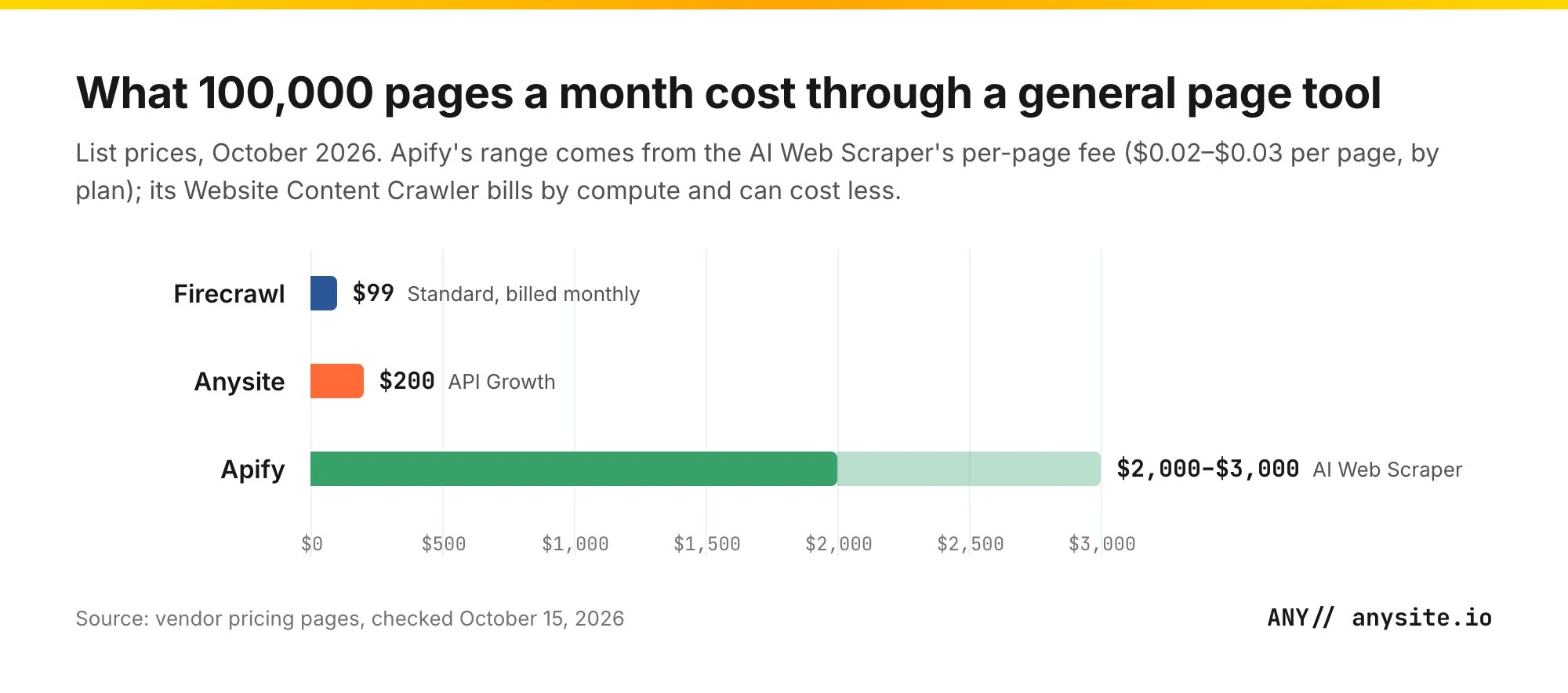
| 100,000 pages via a general page tool | $2,000–$3,000 (AI Web Scraper) | $99/month Standard | $200/month API Growth |
| Unused allowance | Expires each cycle | Rolls over only on Scale | Plan credits reset monthly; top-ups roll over 12 months |
Firecrawl wins the page-text math. At 100,000 basic scrapes, its Standard plan costs half of Anysite's API Growth plan, and a small fraction of Apify's AI Web Scraper. Apify's cheaper path for plain text is Website Content Crawler, which bills by compute. Its cost depends on the site and your settings, so test it on your own pages.
Speed and output: our own test
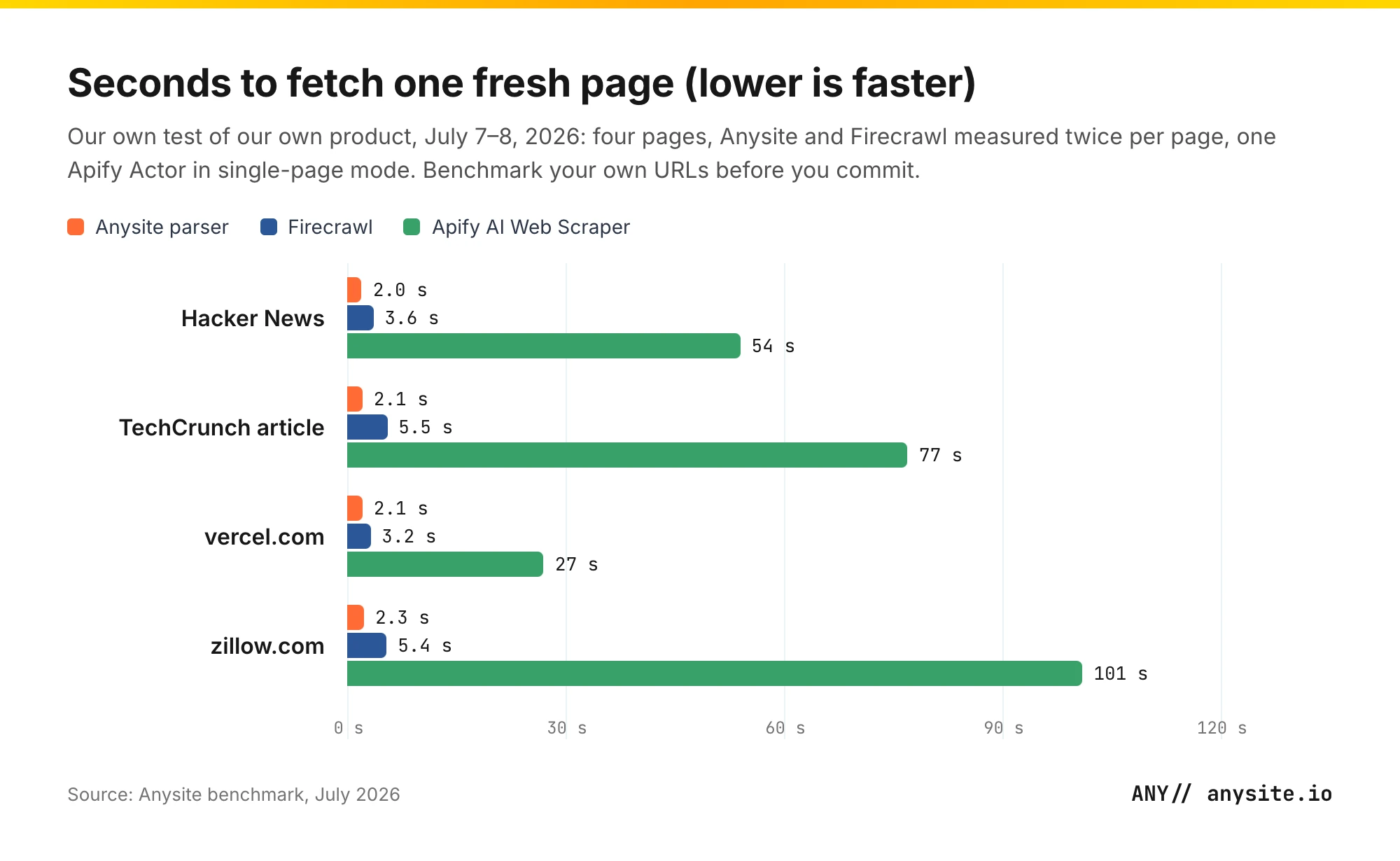
We ran four pages through all three on July 7–8, 2026. The pages were Hacker News (static), a TechCrunch article, vercel.com (JavaScript-heavy) and zillow.com (bot-protected). Firecrawl ran with maxAge: 0 so every request was fresh. Apify ran its AI Web Scraper in single-page mode. Anysite ran its web parser. Anysite and Firecrawl were measured twice per page.
| Page (seconds, fresh) | Anysite parser | Firecrawl | Apify AI Web Scraper |
|---|---|---|---|
| Hacker News | 2.0 | 3.6 | 54 |
| TechCrunch article | 2.1 | 5.5 | 77 |
| vercel.com | 2.1 | 3.2 | 27 |
| zillow.com | 2.3 | 5.4 | 101 |
Firecrawl was quick on every page, at 3.2–5.5 seconds. Apify's AI Web Scraper took 27–101 seconds, because each request boots an Actor and runs an LLM extraction. That is a different job from fetching a page, and the latency reflects it. Anysite's parser was fastest on all four, at 2.0–2.3 seconds, and returned Zillow's real page.
On output, Firecrawl's clean markdown was the nicest default format for feeding an LLM. Apify returned markdown plus prompt-driven extraction, which is flexible but slow. Anysite returned cleaned page content.
Read these numbers with their limits. This is our own test of our own product, not an independent one. It covers four pages and two runs. It tested one Apify Actor, not Website Content Crawler. Your sites and settings will differ, so benchmark your own URLs before you commit.
Where Anysite fits
Anysite is our product. It is a third option for teams whose agents or pipelines need typed records from many platforms, not page text.
Both Firecrawl and Apify start from a page. Firecrawl gives you the page as markdown, and you parse it. Apify gives you the page through an Actor someone else maintains. Anysite starts from the record instead. It returns typed fields, such as people, companies, posts and prices, "pulled live from the source at the moment you ask."
- Coverage. 900+ sources and 5,000+ endpoints (anysite.io, October 2026), across social media, developer platforms, business intelligence, marketplaces and maps.
- Business data. B2B people and company data, from professional profiles to company search, jobs and an email finder.
- Any URL. For sites without a dedicated endpoint, the web parser handles any URL, and JavaScript-rendered pages are supported.
- Four interfaces, one engine. CLI, MCP, REST API and n8n share one engine. On the API line they share one credit balance.
- MCP for agents. Claude, Cursor, Codex, Gemini CLI and other MCP clients connect to
https://mcp.anysite.io/mcp, on a flat monthly MCP plan. - Self-healing endpoints. "When a website changes its layout, endpoints adapt on our side."
Anysite has real limits. There is no free plan, only a 7-day trial that needs a card. MCP plans have rolling 5-hour and 7-day usage windows. On sites with aggressive bot defenses, results may vary. For plain page-to-markdown at volume, Firecrawl is cheaper and its markdown is better. Browse all source categories to see whether your targets have typed endpoints.
Apify vs Firecrawl vs Anysite at a glance
| Apify | Firecrawl | Anysite | |
|---|---|---|---|
| What it is | Marketplace of Actors plus a cloud to run them | One web data API for AI agents | Live web data API and MCP server |
| What you get back | Whatever each Actor returns | Markdown, JSON, screenshots | Typed JSON per source; parsed page for any URL |
| Coverage | 87,000+ Actors | Any public URL, plus search | 900+ sources, 5,000+ endpoints |
| Speed in our test (July 2026) | 27–101 s (AI Web Scraper) | 3.2–5.5 s fresh | 2.0–2.3 s (parser) |
| Open source | Crawlee library | Core under AGPL-3.0, self-hostable | CLI under MIT |
| Agent access | Hosted MCP server | Official MCP server | MCP server, flat plans |
| Free start (Oct 2026) | $5/month usage | 1,000 credits/month | 7-day trial, card needed |
| Entry price (Oct 2026) | $19/month | $19/month | $30/month MCP; $49/month API |
| Best for | Many niche targets with ready tools | Pages into LLM-ready markdown | Typed records from many platforms |
Who should choose which
Choose Firecrawl if
- you need any page as clean markdown for an LLM, a RAG index or a summarizer;
- you want one API with SDKs in six languages and a free plan to start;
- you want to self-host an open-source core;
- your volume is page-heavy and the $99 Standard plan covers it.
Choose Apify if
- a maintained Actor already exists for your exact target site;
- you want scheduling, storage and proxies in one platform;
- you plan to build and run your own crawlers with Crawlee;
- you need many unrelated, niche sources and prefer ready tools over code.
Choose Anysite if
- your agent needs profiles, companies, posts or prices as typed fields, not text to parse;
- you pull from many platforms and want one key and one schema style;
- you run agents over MCP and want a flat monthly price;
- you also need any-URL parsing for the long tail.
Running two of them
The tools also work side by side. Firecrawl can index documentation and articles as markdown while Anysite supplies records from named platforms. Apify can cover a niche site that neither of the others handles well. An Anysite API key also works on its MCP server, so one balance covers both your scripts and your agents.
Verdict
Firecrawl and Apify both earn their reputations. Firecrawl is the faster, simpler route for page text: fresh scrapes in 3.2–5.5 seconds in our test, the nicest markdown, a free plan and $99 for 100,000 pages. Apify is the broader route: 87,000+ Actors and a full platform, at the cost of slower, pricier general extraction.
Anysite is the choice when the page is not what you want. If your agent needs a company, a person or a price as fields, typed endpoints skip the parsing step. If what you need is markdown from arbitrary pages, Firecrawl remains the better buy.
Frequently asked questions
Is Apify or Firecrawl better? It depends on the job. Firecrawl is better for turning pages into clean markdown for an LLM, fast, with one API. Apify is better when a ready-made tool already exists for your target site, since its Store lists 87,000+ Actors. In our own test (July 7–8, 2026), Firecrawl returned fresh pages in 3.2–5.5 seconds and Apify's AI Web Scraper took 27–101 seconds.
How much does Firecrawl cost? As of October 2026, Firecrawl has a free plan with 1,000 credits a month and no card. Hobby is $19 a month for 5,000 credits, Standard $99 for 100,000, Growth $399 for 500,000 and Scale $749 for 1,000,000. Yearly billing lowers these to $16, $83, $333 and $599 a month. A basic scrape costs 1 credit per page.
How much does Apify cost? As of October 2026, Apify's Free plan includes $5 of monthly usage with no card. Starter is $19 a month, Scale $199 and Business $999, each including the same amount in usage, or 10% less billed yearly. Actors then bill per event or per compute unit; Apify's AI Web Scraper charges $0.02–$0.03 per page by plan.
Which is cheaper for 100,000 pages a month? As of October 2026, Firecrawl Standard covers 100,000 basic scrapes for $99 a month. Apify's AI Web Scraper would cost $2,000–$3,000 for the same pages at $0.02–$0.03 each, before start fees. On Anysite, 100,000 web parser calls fit the $200 API Growth plan at 1 credit each.
How is Anysite different from Apify and Firecrawl? Firecrawl and Apify mostly hand you a page as text, or a tool someone built for one site. Anysite returns typed fields, such as people, companies, posts and prices, from 900+ sources and 5,000+ endpoints over an API or MCP server. As of October 2026, plans start at $30 a month (MCP) and $49 a month (API), with a 7-day trial.
Keep reading
Firecrawl alternatives
Tools that turn pages into data for AI, compared on price, output and best fit.
Apify alternatives
Options for teams that want web data without building or renting Actors.
Anysite MCP server
How agents in Claude, Cursor and other MCP clients reach 900+ sources on a flat monthly plan.
Try Anysite now
Typed web data from 900+ sources, over an API or your agent's MCP client. 7-day free trial.
anysite.io