Apify Alternatives: 7 Web Data Tools for Agents and Pipelines in 2026
TL;DR Apify is a strong platform: a marketplace of 87,000+ ready-to-run actors, a hosted runtime for your own code and an open-source crawling library. If what you want is typed records from many platforms through one API and one MCP server, without picking and vetting actors, pick Anysite. Firecrawl suits teams that want clean markdown of any page for an LLM. Bright Data suits teams that need a large proxy network and ready-made scrapers at volume. Zyte and ScrapingBee suit engineers who want one API that handles access. Browse AI and Octoparse suit people who work without code.
We read each vendor's own site on October 15, 2026 for every price and feature quoted here.
The short list
| Alternative | Built around | Entry price (Oct 2026) | Best for |
|---|---|---|---|
| Anysite | Typed JSON per source, over API, MCP, CLI and n8n | $30/month (MCP), $49/month (API) | Agents and pipelines that need records from many platforms |
| Firecrawl | Page to markdown or JSON for LLMs | Free; $19/month (Hobby) | Feeding page content to an LLM |
| Bright Data | Proxy network, unblocking APIs, ready-made scrapers | Free tier; $1.5 per 1,000 records | High-volume collection from hard sites |
| Zyte | One API with ban handling, billed per success | $5 free credit; from $0.13 per 1,000 responses | Engineering teams running their own crawlers |
| ScrapingBee | Request API with rendering and proxies | $19/month (Hobby) | Simple, predictable request-based extraction |
| Browse AI | No-code robots and change monitoring | Free; $19/month billed annually | Non-developers who want monitored data |
| Octoparse | Desktop and cloud point-and-click builder | Free; from $69/month billed annually | Visual workflow building without code |
For reference, Apify costs $0 on its free plan with $5 of usage a month, then $19, $199 or $999 a month (October 2026).
What Apify does well
Apify calls itself "a marketplace of ready-to-run tools for AI that automate work on the web." Its Store lists "87,000+ ready-to-run tools called Actors." Most of them come from independent creators, who earn from them while Apify runs the infrastructure and billing.
That breadth is the main reason teams pick it. For many sites, someone has already built and published an actor. You fill in a JSON input, run it, and get structured output.
Apify is also a full runtime for your own code. Actors are serverless cloud programs. You can schedule runs from the Console or the API, rotate IPs through Apify Proxy and connect results to other tools. Developers can publish their own actors and get paid. Apify maintains open-source projects, including the Crawlee library.
Apify also runs a hosted MCP server for AI clients, and its free plan renews $5 of usage a month without a card. No other tool here combines a marketplace this large with a place to deploy custom code. For a head-to-head with Firecrawl, including our own speed test, see Apify vs Firecrawl.
Why people look for Apify alternatives
Four reasons come up most.
- Credit math. The bill has layers. Platform usage is priced in compute units ($0.2 down to $0.13 per unit by plan), proxies are billed separately, and many Store actors add per-event charges. Unused prepaid usage expires at the end of each billing cycle.
- Uneven actor quality. Actors are built by many independent creators. Reliability, maintenance and pricing differ from one actor to the next, so each new site means vetting a new tool.
- Latency of general-purpose actors. Starting an actor takes time. In our own test, July 7–8, 2026, Apify's
ai-web-scraperactor took 27 to 101 seconds per page. That is fine for batch jobs and slow for agents that wait on each answer. - Wanting one data model. Teams that pull from ten platforms end up with ten actors, ten output shapes and ten pricing sheets. Some would rather call one API that returns consistent records.
Some of these reasons point away from Anysite. A team that needs a custom crawler for one niche site is often best served by Apify, Zyte or a self-hosted framework.
How we picked these alternatives
Each tool had to clear three bars. It gets data from public websites for a developer, an agent or an analyst. It is on sale today with public pricing. It offers a free plan, a free tier or a trial.
We left out single-platform tools, which replace one actor rather than the platform, and pure proxy resellers.
Anysite is our product. It sits first as the pick for teams whose agents or pipelines need typed records from many platforms, not a marketplace of separate actors. The rest follow from the closest like-for-like swap to the simplest no-code option.
1. Anysite: typed records from 900+ sources through one API and MCP server
Anysite is a live web data layer. Data is "pulled live from the source at the moment you ask — not served from a warehouse snapshot." Instead of a page as text, it returns typed fields: people, companies, posts, prices.
- One catalog, one vendor. "900+ sources and 5,000+ endpoints" (anysite.io, October 2026), covering social media, developer platforms, business intelligence, marketplaces, and local and maps data, plus B2B people and company data.
- Four interfaces, one engine. CLI, MCP, REST API and n8n share the same sources. On the API line they share one credit balance.
- An MCP server built for agents. Meta-tools, including discover, execute, query_cache and export_data, with server-side filtering and sorting of cached results. It works with Claude, Cursor, Codex, Gemini CLI and other MCP clients.
- Any URL as a fallback. The web parser returns title, main content, author, date, links and images from any page. "The parser processes JavaScript-rendered content before extraction."
- An open-source CLI for pipelines. MIT-licensed, with YAML pipelines,
--dry-runcost previews, cron scheduling and loading into PostgreSQL, SQLite, ClickHouse or Parquet. - Maintenance on our side. "When a website changes its layout, endpoints adapt on our side."
In our own test, July 7–8, 2026, Anysite's web parser returned four pages in 2.0 to 2.3 seconds each, against 27 to 101 seconds for Apify's ai-web-scraper actor. That test covered four pages, with two runs each for Anysite and Firecrawl, so read it as a direction.
Pricing (October 2026): The MCP line is flat: MCP $30 a month, MCP x5 $99 and MCP x15 $199, with all sources on every plan. The API line is credit-based: Starter $49 a month for 15K credits, Growth $200 for 100K, Scale $300 for 190K, Pro $549 for 425K and Enterprise $1,199 for 1.2M. A standard request costs one credit. The MCP plan and the API Starter plan have a 7-day free trial; starting it needs a card.
How it differs from Apify: Apify gives you thousands of tools from many authors. Anysite gives you one catalog it maintains itself, with one output style and one bill. Anysite has no free plan, and "niche sites with heavy bot protection are case-by-case." If the site you need is not among Anysite's sources and a well-rated actor exists for it, Apify is the better call.
Pick it if your agent or pipeline pulls from several platforms and you want consistent records without managing actors.
2. Firecrawl: the closest swap for page content
Firecrawl calls itself "the web data API to search and scrape" and "the infrastructure layer that helps AI find, read, and act on the live web." Its endpoints are Search, Scrape, Crawl, Map and a newer Interact. Scrape returns markdown, JSON or screenshots, and you can pass a JSON schema for structured fields. Firecrawl is open source and runs an official MCP server.
In our own test, July 7–8, 2026, fresh Firecrawl requests took 3.2 to 5.5 seconds per page. Its markdown was the nicest default output of the three tools we tried.
Pricing (October 2026): Free with 1,000 credits a month, no card. Hobby is $19 a month ($16 billed annually) for 5,000 credits. Standard is $99 a month ($83 billed annually), Growth $399 ($333) and Scale $749 ($599), for 100,000, 500,000 and 1,000,000 credits. One basic page costs one credit. JSON and some other formats add 4 credits per page.
How it differs from Apify: Firecrawl does one job across any site: turn pages into LLM-ready content. There is no marketplace and no custom code runtime. For site-specific records such as listings or profiles, you design the schema and handle the result yourself.
Pick it if your main need is clean markdown of arbitrary pages for retrieval or an agent.
3. Bright Data: proxy scale and ready-made scrapers
Bright Data describes itself as "the web's data, unlocked." It sells four layers: a dataset marketplace and scraper APIs, data feeds, web access APIs (Unlocker, SERP, Browser and Crawl) and proxy infrastructure. It cites "400M+ proxy IPs from 195 countries." Its data feeds cover "5B+ records … across 800+ domains."
Pricing (October 2026): The Web Scraper API has a free tier of 5,000 records a month with no card. Pay as you go is $1.5 per 1,000 records. The Scale plan is $499 a month for 384,000 records, then $1.3 per 1,000. Web Unlocker follows the same pattern: 5K free requests a month, $1.5 per 1,000, or $499 a month for 383K. Enterprise pricing is on request.
How it differs from Apify: Bright Data owns its proxy network, which is far larger than anything else in this list. Its ready-made scrapers come from one vendor, not a community, so the catalog is smaller than Apify's Store but more uniform.
Pick it if you collect at high volume from sites that block hard, and proxy coverage matters more than catalog breadth.
4. Zyte: one API that handles bans, for engineering teams
Zyte's headline is "Web data, solved." The Zyte API is "one API across easy, moderate and hard websites." It picks the lightest access method and escalates only when a site requires it. You pay only for successful requests. Zyte also maintains the open-source Scrapy framework, hosts crawlers on Scrapy Cloud and runs a managed data service.
Pricing (October 2026): Prices are per 1,000 successful responses and depend on site difficulty, from tier 1 to tier 5. Pay as you go starts at $0.13 per 1,000 HTTP responses and $1.01 per 1,000 browser responses on the easiest sites. Monthly commitments of $100, $200 or $500 lower those rates, down to "$0.06 per 1,000 successful responses." Hard sites cost up to $16.08 per 1,000 browser responses on pay as you go. New accounts get $5 of free credit for 30 days.
How it differs from Apify: Zyte is closest to Apify's "run your own crawler" side. You write spiders in Scrapy and let Zyte handle access and hosting. It has no public marketplace of community tools.
Pick it if your team writes its own crawlers and wants bans and proxies handled, with a bill only for successes.
5. ScrapingBee: a plain request API with predictable credits
ScrapingBee sells "the best web scraping API to avoid getting blocked." You send a URL, and it handles headless Chrome, proxy rotation and geolocation. It also offers AI extraction ("Describe the fields, get back structured JSON"), screenshots and a dedicated search-results endpoint.
Pricing (October 2026): Hobby is $19 a month for 75,000 credits, Freelance $49 for 250,000, Startup $99 for 1,000,000 and Business $249 for 3,000,000. Larger plans run up to $5,799 a month. A trial gives 1,000 free credits with no card. Credit use depends on options: a JavaScript-rendered request costs 5 credits, premium proxies 10 to 25, and stealth proxies 75.
How it differs from Apify: ScrapingBee is one endpoint, not a platform. You do not browse a catalog or deploy code; you call an API and parse the result. The bill is easy to forecast once you know which proxy level each site needs.
Pick it if you want a simple API for a known list of sites and prefer one predictable plan.
6. Browse AI: no-code robots with monitoring
Browse AI promises to "scrape and monitor data from any website reliably at scale." You point a robot at a page, and its AI extracts the data. Robots can watch pages and alert you to changes. Results flow to "7,000+ tools and apps." The site cites "770,000+ users."
Pricing (October 2026): Free forever with 50 credits a month. Personal is $19 a month billed annually (12,000 credits a year) or $48 billed monthly (2,000 credits a month). Professional is $69 a month billed annually or $87 monthly, from 5,000 credits a month. Premium starts at $500 a month, billed annually. One credit covers 10 rows or one screenshot; premium sites cost 2 to 10 credits per run.
How it differs from Apify: Browse AI is built for people who do not write code. Its prebuilt robots number in the hundreds, not tens of thousands. Monitoring is a first-class feature rather than something you schedule yourself.
Pick it if you are an analyst or operator who wants monitored tables from a few sites without code.
7. Octoparse: a visual workflow builder on a budget
Octoparse is a point-and-click builder that runs on your desktop and in its cloud.
Pricing (October 2026): Free forever with no card: 10 tasks, 1 device and up to 50,000 exported rows a month. Standard starts at $69 a month billed annually, with 100 tasks and up to 3 cloud processes. Professional is $249 a month billed annually, with 250 tasks and up to 20 cloud processes. Paid plans carry a 5-day money-back guarantee.
How it differs from Apify: Octoparse replaces Apify for people who would never write an actor. It has no API-first catalog and no marketplace on Apify's scale.
Pick it if you want a visual tool for a handful of recurring extraction tasks and a low starting price.
Apify alternatives: pricing compared
| Tool | Pricing model | Entry price (Oct 2026) | Free or cheapest start |
|---|---|---|---|
| Anysite | Flat MCP plans; API credits per month | $30/month (MCP), $49/month (API) | 7-day free trial, card needed |
| Firecrawl | Credits per page | $19/month (Hobby) | Free, 1,000 credits/month |
| Bright Data | Per 1,000 records or requests | $1.5 per 1,000 records | Free tier, 5,000 records/month |
| Zyte | Per 1,000 successful responses, by site difficulty | From $0.13 per 1,000 (HTTP, pay as you go) | $5 credit for 30 days |
| ScrapingBee | Credits per request, by options | $19/month (Hobby) | 1,000 trial credits |
| Browse AI | Credits per rows extracted | $19/month billed annually | Free, 50 credits/month |
| Octoparse | Plan tiers by tasks and cloud processes | $69/month billed annually | Free, 10 tasks |
| Apify (for reference) | Prepaid usage, compute units, plus actor fees | $19/month (Starter) | Free, $5 usage/month |
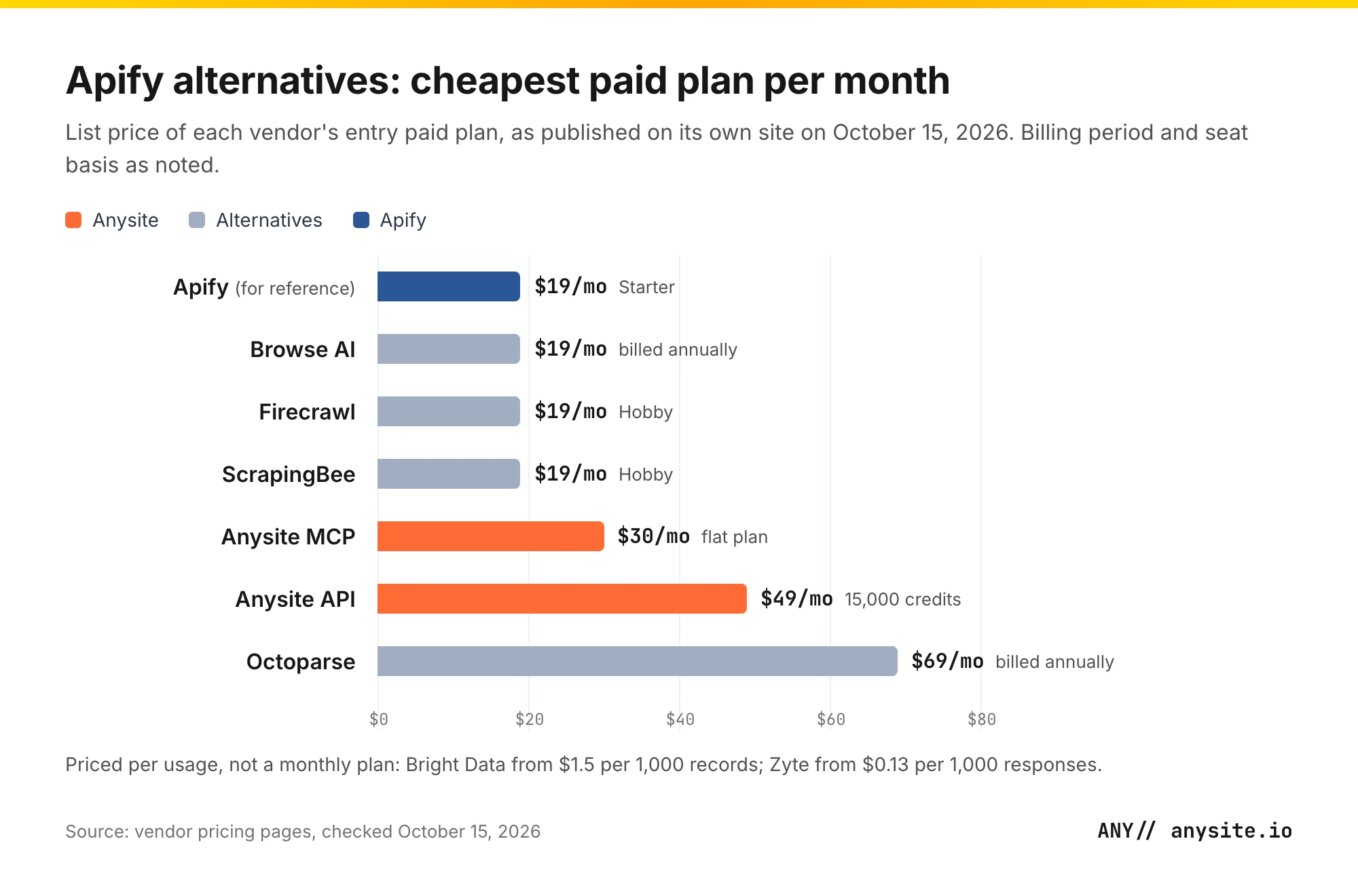
The entry price rarely tells you the full bill. On Apify, three meters run at once: compute units, proxies and the fees each actor sets. On Zyte and ScrapingBee, the same page costs more when a site needs a browser or premium proxies. Anysite has two lines. MCP plans are flat, with two rolling usage windows, one of 5 hours and one of 7 days; reaching a limit returns a rate-limit error and nothing is lost. API plans include a monthly credit allowance, with top-ups at $2.90 per 1K credits that roll over for 12 months.
Which Apify alternative should you choose?
Name the reason you are leaving, then match it.
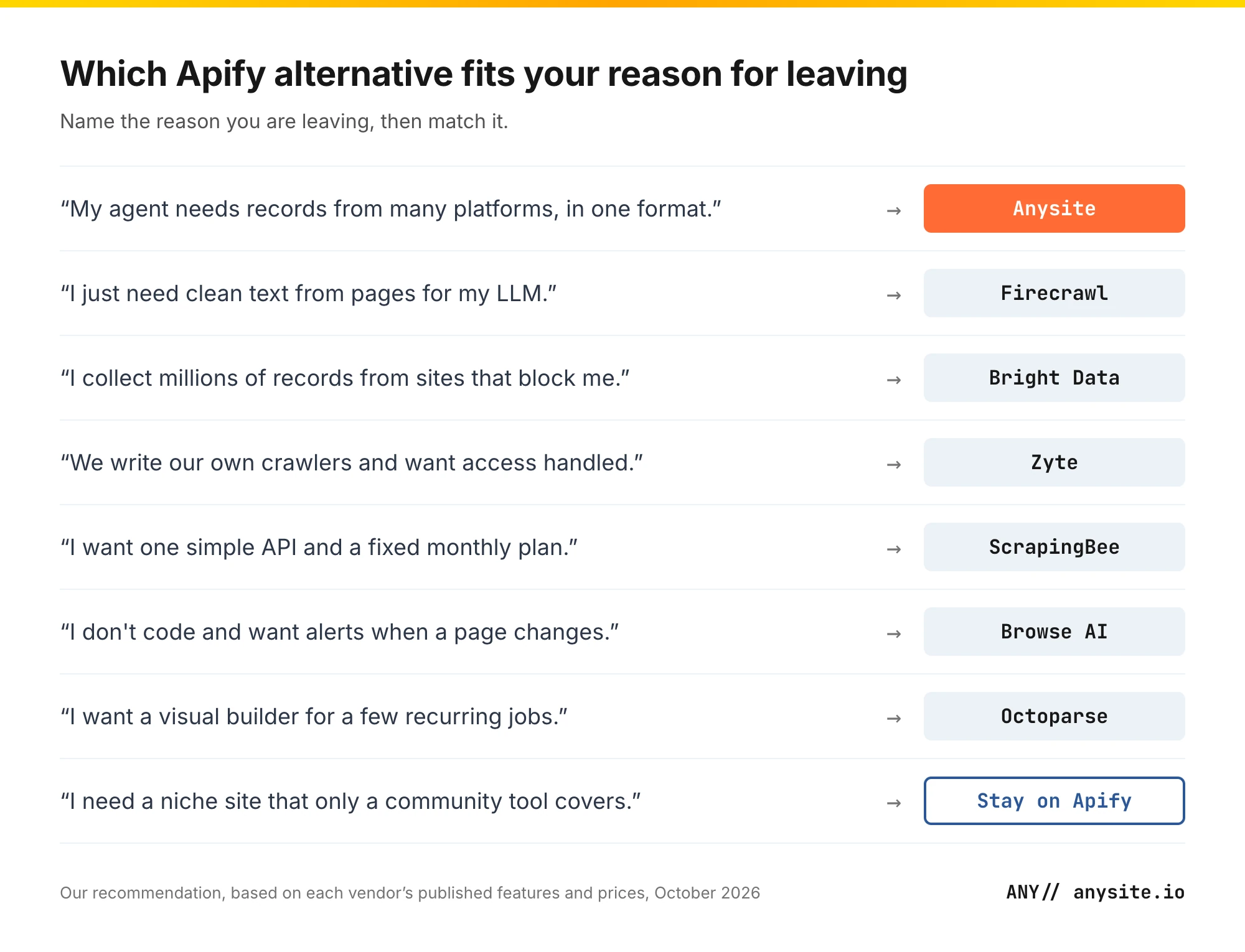
- "My agent needs records from many platforms, in one format." Anysite.
- "I just need clean text from pages for my LLM." Firecrawl.
- "I collect millions of records from sites that block me." Bright Data.
- "We write our own crawlers and want access handled." Zyte.
- "I want one simple API and a fixed monthly plan." ScrapingBee.
- "I don't code and want alerts when a page changes." Browse AI.
- "I want a visual builder for a few recurring jobs." Octoparse.
- "I need a niche site that only a community tool covers." Stay on Apify.
Staying on Apify is a fair answer too. If a well-maintained actor already covers your site, its per-event price fits your volume, and you value deploying your own code next to it, Apify does that better than anyone on this list.
Frequently asked questions
What is the best Apify alternative?
It depends on why you are leaving. Anysite fits teams that want typed records from many platforms over API or MCP without choosing actors. Firecrawl fits teams that want clean page markdown for an LLM. Bright Data and Zyte fit teams that mostly need to get through blocked sites at volume.
How much does Apify cost?
As of October 2026, Apify has a free plan with $5 of usage a month and no card. Paid plans are Starter at $19 a month, Scale at $199 and Business at $999, or about 10% less billed annually. Many Store actors add their own per-event charges on top of platform usage.
Is there a free alternative to Apify?
As of October 2026, several alternatives have free plans: Firecrawl gives 1,000 credits a month, Bright Data 5,000 records a month on its Web Scraper API, Browse AI 50 credits a month and Octoparse 10 tasks, all without a card. ScrapingBee gives 1,000 trial credits and Zyte $5 of credit for 30 days. Anysite has no free plan; it offers a 7-day free trial that needs a card to start.
Which Apify alternative is best for a small team?
As of October 2026, a small team that works through an AI agent can start on Anysite's MCP plan at $30 a month, flat. A team that wants point-and-click extraction without code can start on Browse AI or Octoparse free plans. A developer who only needs page markdown can start on Firecrawl's Hobby plan at $19 a month.
How is Anysite different from Apify?
Apify is a marketplace of 87,000+ actors, most built by independent creators, so quality and pricing vary by actor. Anysite runs its own 900+ sources and 5,000+ endpoints behind one API, one MCP server and one balance, and returns typed fields. Apify wins on breadth of the long tail and on custom code you deploy yourself.
Keep reading
Firecrawl alternatives
Page-to-markdown tools and data APIs compared, with October 2026 prices.
Bright Data alternatives
Unblocking APIs, proxy networks and typed data layers, side by side.
Anysite MCP server
How the MCP line works: meta-tools, flat plans and rolling usage windows.
Try Anysite now
Connect your agent to 900+ sources and get typed records back. The MCP and Starter plans start with a 7-day free trial.
anysite.io