ScrapingBee Alternatives: 6 APIs for Web Data at Any Volume in 2026
TL;DR ScrapingBee is a well-built scraping API that handles headless browsers and rotating proxies, from $19 a month. If what you want is typed records per platform, delivered to an agent or a pipeline instead of a page to parse, pick Anysite. ZenRows is the closest like-for-like swap, with nearly the same credit costs and a free monthly plan. Scrapfly is built for the hardest anti-bot targets. ScrapingAnt has the most free credits and no concurrency cap. ScraperAPI is a single endpoint with structured e-commerce and search data. Firecrawl turns pages into clean markdown for LLMs.
We read each vendor's own site on October 15, 2026 for every price and feature quoted here.
The short list
| Alternative | Built around | Entry price (Oct 2026) | Best for |
|---|---|---|---|
| Anysite | Typed JSON per source, over API, MCP, CLI and n8n | $30/month (MCP), $49/month (API) | Agents and pipelines that need records, not pages |
| ZenRows | Fetch, Extract, Crawl, Batch and Browser on one credit balance | $0 free plan; $19/month Build | A like-for-like move off ScrapingBee |
| Scrapfly | Scraping, extraction, screenshot and crawler APIs plus a cloud browser | $0 free plan; $30/month Discovery | Heavily protected targets |
| ScrapingAnt | One rendering endpoint with rotating proxies | $0 free plan; $19/month Enthusiast | High parallelism on a small budget |
| ScraperAPI | One scraping endpoint plus structured data endpoints | $49/month Hobby | Amazon, Google and Walmart data at volume |
| Firecrawl | Page-to-markdown for LLMs: scrape, crawl, search | $0 free plan; $19/month Hobby | Feeding web pages into AI apps |
For reference, ScrapingBee costs $19 a month for 75,000 API credits on its Hobby plan, and a default request costs 5 credits (October 2026).
What ScrapingBee does well
ScrapingBee's headline is "The Best Web Scraping API to Avoid Getting Blocked." It promises to "Scrape websites with our powerful web scraping API, without managing proxies, browsers, or anti-bot defenses."
The feature set is complete for its price. ScrapingBee offers an HTML API, AI data extraction, a markdown scraper, screenshots, JavaScript scenarios and CSS or XPath extraction rules. Dedicated APIs cover Google Search, Amazon, Walmart, YouTube, ChatGPT and Gemini.
The entry plan is not stripped down. The $19 Hobby plan includes JavaScript rendering, rotating and premium proxies, geotargeting, screenshots and extraction rules, and the dedicated scraping APIs. Only priority support, an account manager and team management are reserved for higher tiers.
Billing is fair on failure. The FAQ says, "We only charge for successful requests, i.e returning with a 200, 404 or 410 status code." Auto-Mode tries cheaper configurations first and charges 0 credits if every configuration fails.
The tooling has kept up with agents. ScrapingBee lists a CLI, an MCP server, and integrations with n8n, Make, Zapier, Claude Code, Codex and Cursor. It says it is "Trusted by 4,500+ developers."
Why people look for ScrapingBee alternatives
Four reasons come up most.
- Credit math. A request costs 1 to 75 credits. JavaScript rendering is on by default at 5 credits, premium proxies cost 10 or 25, and the stealth proxy costs 75. The 75,000 Hobby credits buy 15,000 default requests, or 1,000 stealth requests.
- Pages, not records. The core product returns a page. You still parse HTML or markdown and keep selectors working when sites change.
- Concurrency per tier. Hobby allows 25 concurrent requests and Freelance 50. Bigger parallel jobs mean a bigger plan, even when the credit volume is small.
- Free tier. The 1,000 free credits are a one-time trial. Teams that want a standing free allowance look at ZenRows, ScrapingAnt or Firecrawl.
Some of these reasons point away from Anysite. If you want raw HTML from arbitrary URLs at the lowest price per page, a scraping API like ScrapingBee or ScrapingAnt is the better fit.
How we picked these alternatives
Every tool here had to meet three bars:
- It returns web data through an API, with proxies and rendering handled by the vendor.
- It is on sale today, with prices on its own site.
- It offers a free plan, free credits or a trial.
We left out pure proxy networks and single-platform tools.
Anysite is our product. It sits first as the pick for teams whose agents or pipelines need typed records from many platforms, not page HTML. The rest run from the closest like-for-like swap to the most specialised option.
1. Anysite: typed records from 900+ sources instead of pages
Anysite is live web data over an API or an MCP server. Data is "pulled live from the source at the moment you ask — not served from a warehouse snapshot." You ask for a company, a person, a post or a price, and you get typed fields back.
- Coverage. 900+ sources and 5,000+ endpoints (anysite.io, October 2026), across social media, developer platforms, business intelligence, marketplaces and maps.
- Four interfaces, one engine. CLI, MCP, REST API and n8n share one engine. An API key also works on the MCP server.
- MCP for agents. Claude, Cursor, Codex, Gemini CLI and other MCP clients connect to
https://mcp.anysite.io/mcp. Meta-tools let the agent discover endpoints, run them and filter cached results. - Any URL, typed JSON back. For sites without a dedicated endpoint, the web parser handles any URL and strips navigation and ads. JavaScript-rendered pages are supported.
- Business data and datasets. B2B people and company data, with 850M+ professional profiles and 70M+ company profiles on the datasets page. Datasets ship as CSV, JSON or Parquet, with a free sample first.
- Self-healing endpoints. "When a website changes its layout, endpoints adapt on our side."
Pricing (October 2026): The MCP line is flat: MCP $30 a month, MCP x5 $99 a month, MCP x15 $199 a month; usage runs in rolling windows (pricing). The API line is credit-based: Starter $49 a month for 15K credits, up to Enterprise at $1,199 a month for 1.2M credits (API pricing). One credit is one standard request, including the web parser on any URL. Both lines have a 7-day free trial; creating the account takes no card, starting the trial does.
How it differs from ScrapingBee: ScrapingBee sells the fetch, and you build the parsing on top. Anysite sells the record, already typed, for each source. For raw pages from arbitrary URLs, ScrapingBee is cheaper per page: its $19 Hobby plan buys 75,000 credits against Anysite Starter's 15K at $49. On sites with aggressive bot defenses, Anysite's results may vary, which is the honest limit of any-URL extraction. Anysite also has no free plan, only a trial that needs a card.
Pick it if your agents or pipelines need typed records from many platforms and you are tired of maintaining parsers.
2. ZenRows: the closest like-for-like swap
ZenRows' headline is "Reliable web data when the web fights back." It calls itself "AI web data infrastructure for agents, applications, and data teams." The platform has five primitives: Fetch returns HTML, markdown, text or PDF; Extract turns a page into JSON without selectors; Crawl follows links; Batch runs thousands of URLs as one job; Browser keeps a session for logins and clicks. An MCP server at https://mcp.zenrows.com/mcp and a CLI cover agents.
Pricing (October 2026): The free plan gives 5,000 credits a month with 5 concurrent requests and no card. Build runs $19 to $39 a month for 45,000 to 120,000 credits. Launch runs $69 to $129 for 250,000 to 700,000 credits, and Growth $199 to $399 for 1.2M to 3M credits. A standard request costs 1 credit, JavaScript rendering 5, a premium proxy 10, and both together 25. Annual billing saves 17%. "Failed requests are never charged."
How it differs from ScrapingBee: The credit costs for standard, rendered and premium requests match ScrapingBee's, so migration is mostly a change of endpoint. ZenRows adds a standing free plan and a persistent browser session. Extract is free on top of the Fetch request it uses, while ScrapingBee adds 5 credits for AI extraction.
Pick it if you like ScrapingBee's model and want a free monthly allowance and free structured extraction.
3. Scrapfly: built for the hardest targets
Scrapfly's headline is "Scrape any public site, drive any browser, power any agent. One API key." The product set is broad: a Web Scraping API, a Cloud Browser driven over CDP for Playwright and Puppeteer, a Screenshot API, an Extraction API, a Crawler API, an AI Browser Agent and an MCP server. Its Unblocker (formerly ASP) handles anti-bot systems, with guides for Cloudflare, Akamai, DataDome, PerimeterX and Kasada. SDKs cover Python, TypeScript, Go and Rust, plus a Scrapy extension. Failed requests are not billed.
Pricing (October 2026): The free plan has 1,000 API credits on signup, 5 concurrent requests and no card. Discovery is $30 a month for 200,000 credits, Pro $100 for 1,000,000, Startup $250 for 2,500,000 and Enterprise $500 for 5,500,000. Extra credits cost from $5.00 down to $1.20 per 10,000. Annual billing gives "2 months free (16% off)." Credit costs per feature are not listed on the pricing page; an estimator and a cost=true API flag show them per configuration.
How it differs from ScrapingBee: Scrapfly puts more weight on protected sites and on browser automation, with a hosted browser your own Playwright code can drive. Pay-as-you-go overflow on Pro and up means a big month does not stop your jobs. The trade-off: per-request costs need the estimator to forecast.
Pick it if your targets sit behind strong bot protection or you need a cloud browser for multi-step flows.
4. ScrapingAnt: more credits and no concurrency cap
ScrapingAnt's headline is "Web data infrastructure for builders." It offers a Web Scraping API that renders pages in real Chrome, LLM-ready markdown, an AI Data Scraper, an MCP server, standalone proxies and custom datasets. It cites 3M+ proxy IPs across 100+ countries and advertises "Unlimited parallel requests" with no concurrency cap on any plan.
Pricing (October 2026): The free plan gives 10,000 API credits a month with no card. Enthusiast is $19 a month for 100,000 credits, Startup $49 for 500,000, Business $249 for 3,000,000 and Business Pro $599 for 8,000,000. Custom plans start at $699 a month for 10M+ credits. A simple request with a datacenter proxy costs 1 credit. A rendered request costs 10, and a rendered request on a residential proxy costs 125.
How it differs from ScrapingBee: The plan prices line up almost exactly with ScrapingBee's, with more credits at each tier. The default rendered request costs 10 credits rather than 5, and residential rendering is expensive at 125. No concurrency cap is the clearest advantage for bursty jobs.
Pick it if you run many requests in parallel and want the largest free allowance on this list.
5. ScraperAPI: one endpoint with structured e-commerce data
ScraperAPI's headline is "Scale Data Collection with a Simple API." It lets you "Collect data from any public website" without managing proxies, browsers or CAPTCHAs. It cites "a global pool of over 40M proxies located across +50 countries." Structured endpoints return data for Amazon products, search and offers, Google search, shopping, news and jobs, and Walmart. An Asynchronous API and DataPipeline cover larger runs.
Pricing (October 2026): Hobby is $49 a month for 100,000 API credits and 20 concurrent threads. Startup is $149 for 1,000,000, Business $299 for 3,000,000 and Scaling $475 for 5,000,000. Annual billing takes 10% off. The trial lasts 7 days with 5,000 API credits and no credit card.
How it differs from ScrapingBee: ScraperAPI's entry plan is $49 rather than $19, and its credits are not priced the same way, so compare on your own request mix. Beyond Google search, it lists separate structured endpoints for Google Shopping, News and Jobs. Its home page does not mention an MCP server, while ScrapingBee ships one.
Pick it if most of your volume is Amazon, Google or Walmart data and you want structured JSON for it.
6. Firecrawl: pages as clean markdown for LLMs
Firecrawl calls itself "the web data API to search, scrape, and interact with the web at scale." Scrape turns a URL into markdown by default, with HTML, screenshots, metadata and schema-based JSON as options. Crawl, Search and Interact cover whole sites, search results and clicks. It is open source, with an MCP server and a CLI. Firecrawl says it is "Trusted by 150,000+ companies of all sizes." In our own test of four pages (July 7–8, 2026), Firecrawl "produces the nicest markdown" of the three tools we compared.
Pricing (October 2026): The free plan gives 1,000 credits a month with no card. Hobby is $19 a month billed monthly, or $16 a month billed annually, for 5,000 credits. Standard is $99 a month billed monthly or $83 billed annually for 100,000 credits, Growth $399 or $333 for 500,000, and Scale $749 or $599 for 1,000,000. A scrape or crawled page costs 1 credit, and JSON output adds 4 credits per page.
How it differs from ScrapingBee: Firecrawl is designed around LLM input, with markdown as the default output rather than HTML. Its credits are scarcer per dollar at the low end: 5,000 for $19 against ScrapingBee's 75,000.
Pick it if your pages go straight into a model and markdown quality matters more than raw volume.
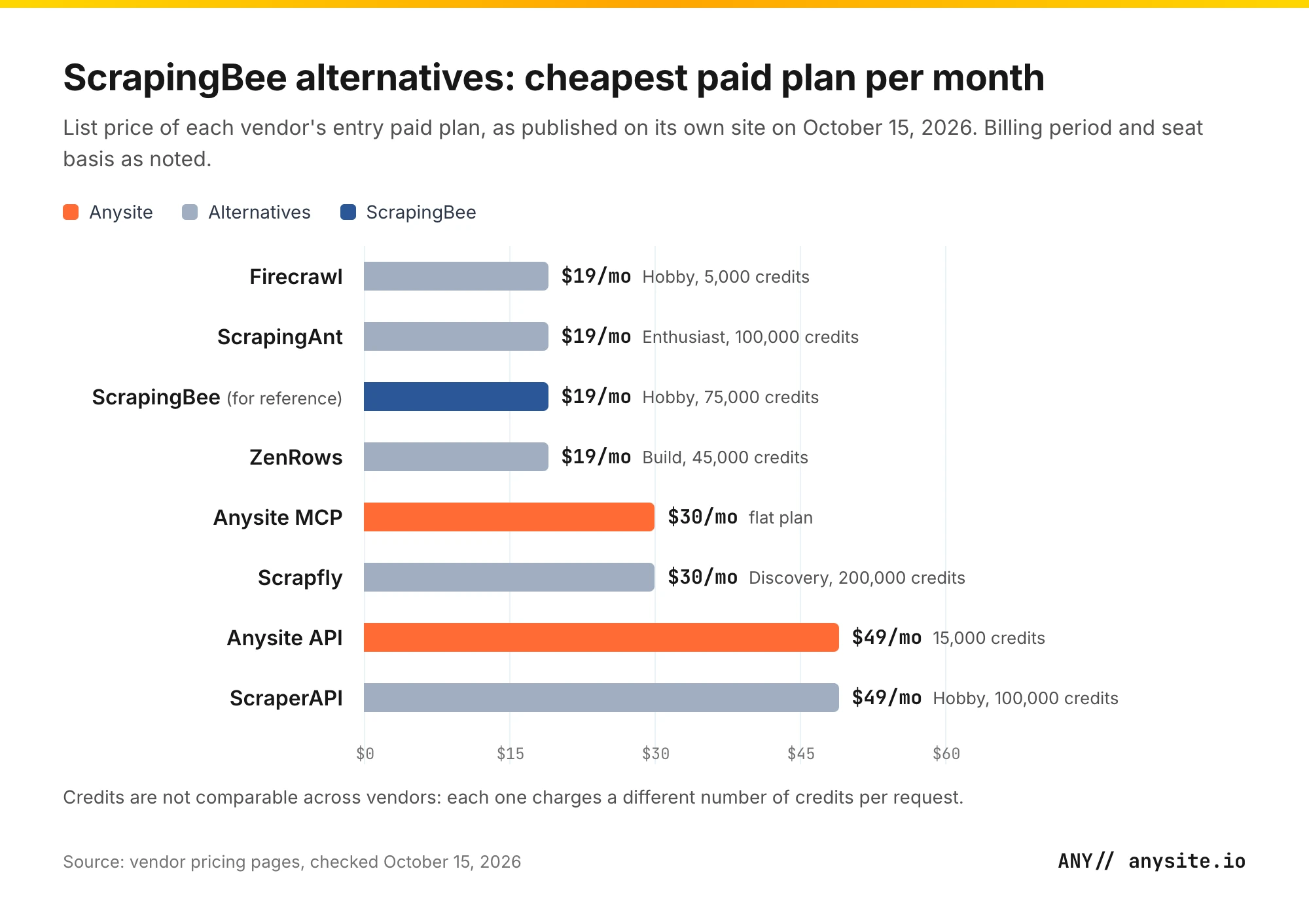
ScrapingBee alternatives: pricing compared
| Tool | Pricing model | Entry price (Oct 2026) | Free or cheapest start |
|---|---|---|---|
| Anysite | Flat MCP plans; API credits per month | $30/month (MCP), $49/month (API) | 7-day trial, card needed to start |
| ZenRows | Monthly credits, 1–25 per request | $19/month Build (45,000 credits) | Free plan, 5,000 credits a month, no card |
| Scrapfly | Monthly credits, cost by feature | $30/month Discovery (200,000 credits) | 1,000 credits on signup, no card |
| ScrapingAnt | Monthly credits, 1–125 per request | $19/month Enthusiast (100,000 credits) | Free plan, 10,000 credits a month, no card |
| ScraperAPI | Monthly API credits | $49/month Hobby (100,000 credits) | 7-day trial, 5,000 credits, no card |
| Firecrawl | Monthly credits, 1 per page | $19/month Hobby (5,000 credits) | Free plan, 1,000 credits a month, no card |
| ScrapingBee (for reference) | Monthly credits, 1–75 per request | $19/month Hobby (75,000 credits) | 1,000 credits once, no card |
The entry price rarely tells you the full bill. Credit counts are not comparable across vendors, because each one prices rendering and proxies differently. A rendered request costs 5 credits on ScrapingBee and ZenRows, 10 on ScrapingAnt, and 1 on Firecrawl. Protected sites push every bill up: 75 credits per stealth request on ScrapingBee, 125 per rendered residential request on ScrapingAnt.
Anysite has its own caps. MCP plans are flat, but each one has rolling 5-hour and 7-day usage windows; hitting a limit returns a rate-limit error, and nothing is lost. API plans include a fixed number of credits per month. Richer payloads cost more than one credit, and top-ups are $2.90 per 1K credits.
Which ScrapingBee alternative should you choose?
Name the reason you are leaving, then match it.
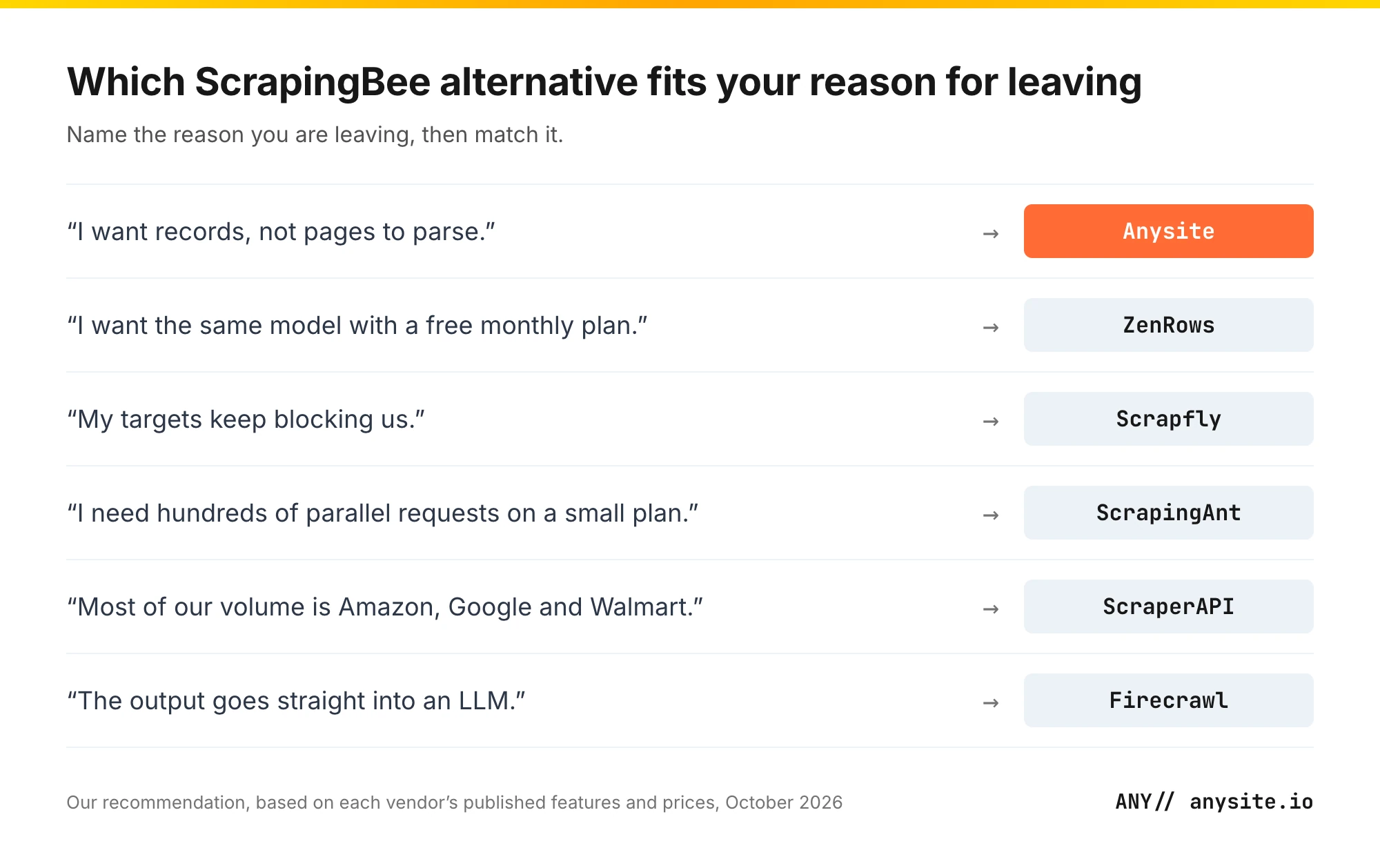
- "I want records, not pages to parse." Anysite.
- "I want the same model with a free monthly plan." ZenRows.
- "My targets keep blocking us." Scrapfly.
- "I need hundreds of parallel requests on a small plan." ScrapingAnt.
- "Most of our volume is Amazon, Google and Walmart." ScraperAPI.
- "The output goes straight into an LLM." Firecrawl.
- "My agent needs live data through MCP." Anysite, with ZenRows, Scrapfly, ScrapingAnt and Firecrawl also offering MCP servers.
You may not need to leave at all. If most of your pages render with a classic proxy, $19 a month buys 15,000 rendered requests with geotargeting and screenshots included. ScrapingBee does not charge for failed requests, and Auto-Mode with max_cost keeps hard pages from draining the balance.
Frequently asked questions
What is the best ScrapingBee alternative?
It depends on why you are leaving. For typed records from many platforms over an API or an MCP server, instead of HTML from a URL, Anysite is the pick. For the same credit model with a free monthly plan, ZenRows is the closest swap. For hard anti-bot targets and a hosted browser, Scrapfly is the strongest option.
How much does ScrapingBee cost?
As of October 2026, ScrapingBee plans start at $19 a month for 75,000 API credits (Hobby), then $49 for 250,000, $99 for 1,000,000 and $249 for 3,000,000. A default request with JavaScript rendering costs 5 credits, and a stealth proxy request costs 75. New accounts get 1,000 free credits with no card.
Is there a free alternative to ScrapingBee?
As of October 2026, ScrapingAnt has a free plan with 10,000 API credits a month and ZenRows a free plan with 5,000 credits a month, both with no card. Firecrawl's free plan gives 1,000 credits a month. ScrapingBee itself gives 1,000 free credits once, on signup.
Which ScrapingBee alternative is best for a small team?
As of October 2026, Anysite's MCP plan at $30 a month covers all 900+ sources at a flat monthly price, with usage in rolling windows. For a plain HTML API on a small budget, ScrapingAnt's Enthusiast plan is $19 a month for 100,000 credits with no concurrency cap. ZenRows Build starts at $19 a month for 45,000 credits.
How is Anysite different from ScrapingBee?
ScrapingBee fetches a URL for you and returns the page, with proxies and a headless browser handled on its side. Anysite returns typed fields, such as people, companies, posts and prices, pulled live from 900+ sources over an API or MCP server. Anysite plans start at $30 a month (MCP) and $49 a month (API) as of October 2026.
Keep reading
Firecrawl alternatives
Page-to-markdown APIs compared for agents and LLM pipelines, with October 2026 prices.
Bright Data alternatives
Proxy networks, scraper APIs and typed data APIs, and what each costs at volume.
Anysite MCP server
How agents connect to 900+ sources through one MCP endpoint, and what each plan includes.
Try Anysite now
Typed records from 900+ sources, over API or MCP, with a 7-day free trial.
anysite.io