Clay Alternatives: 6 Tools for B2B Data, Enrichment and AI Agents in 2026
TL;DR Clay is a strong GTM workspace: a table with 200+ data and AI vendors in its marketplace, waterfall enrichment and AI research agents. If what you want is for your AI agent to pull live B2B people and company data on its own, pick Anysite. Apollo bundles a large contact database with sequences. Databar is the closest table-style swap with an API and MCP server. Freckle copies the Clay model with simpler output-based credits. Unify runs AI outbound per seat. Origami lets you build lists by chatting with an agent.
We read each vendor's own site on October 15, 2026 for every price and feature quoted here.
The short list
| Alternative | Built around | Entry price (Oct 2026) | Best for |
|---|---|---|---|
| Anysite | Data API and MCP server, typed JSON per source | $30/month (MCP), $49/month (API) | AI agents and pipelines that need live data from many platforms |
| Apollo | Contact database plus sales engagement | $0, paid from $49/seat/month billed annually | Sales teams that want data and sequences in one tool |
| Databar | Enrichment tables with API, SDK and MCP | $99/month | Clay-style tables that developers can also call over REST |
| Freckle | Enrichment tables priced per output | $0, paid from $99/month | Teams that like Clay but want a simpler bill |
| Unify | AI outbound with built-in data | $0, paid from $20/seat/month | Small teams running signal-based outbound |
| Origami | Chat-based prospecting agent | $99/month | Founders who want lists built by asking in plain language |
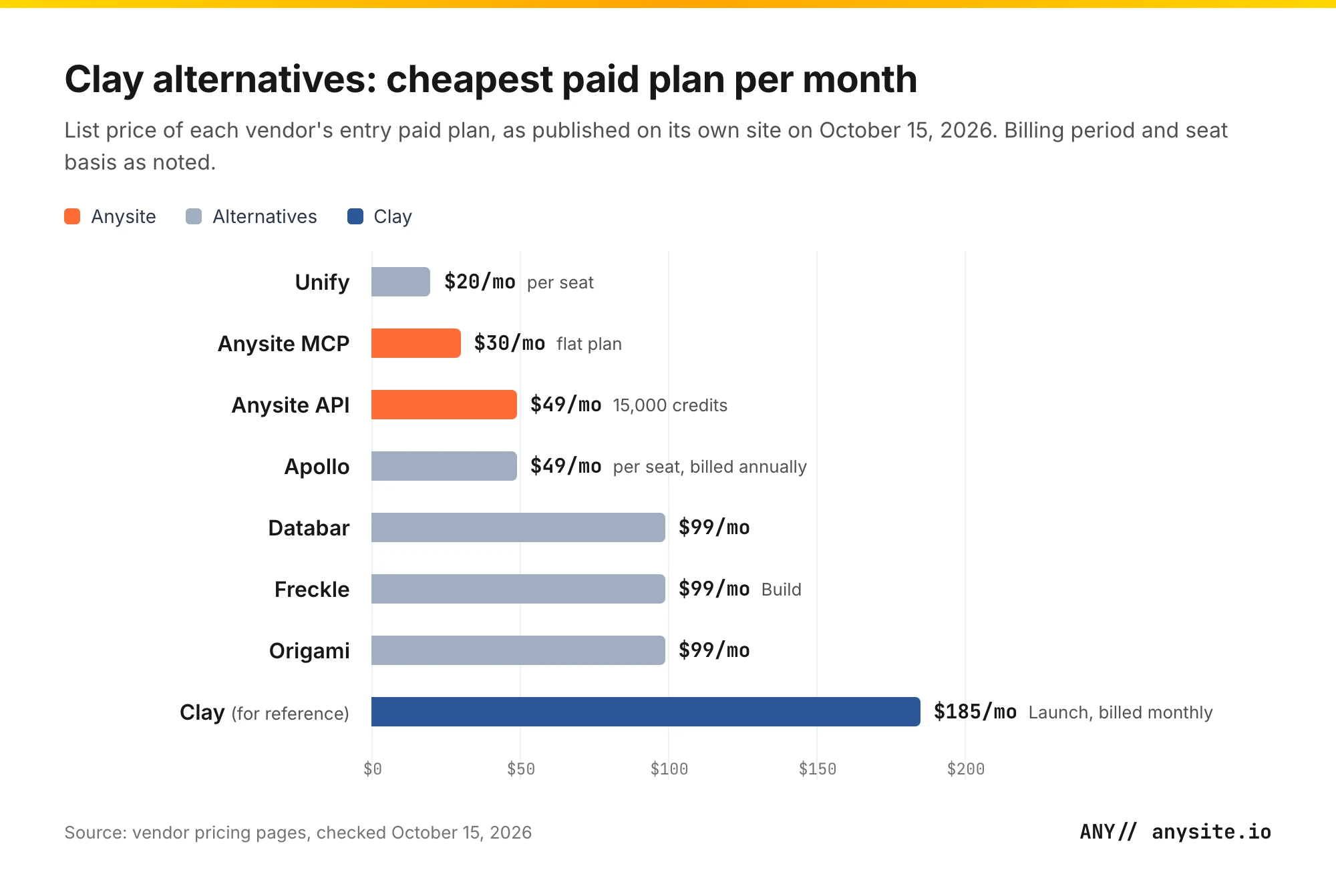
For reference, Clay costs $185 a month on its Launch plan with monthly billing, or $167 a month on annual billing (October 2026).
What Clay does well
Clay calls itself "infrastructure to get any data, run agentic workflows, and launch GTM plays." In practice it is a spreadsheet where each column can call a data provider, an AI model or another tool. The homepage says Clay's marketplace holds "200+ data and AI vendors."
Waterfall enrichment is the feature most teams buy it for. A waterfall tries one email or phone provider after another until one returns a match. That raises match rates without you signing contracts with each vendor.
Claygent, Clay's AI research agent, fills columns that no provider sells. It reads a company's site and answers a question such as "does this company sell to hospitals?" Clay also adds Audiences, signals such as job changes, CRM sync and its own email sequencer.
The free plan is real. It includes unlimited seats and tables, multi-provider waterfalls, Claygent and bring-your-own API keys, with 500 actions and 100 data credits a month. Clay says more than 500,000 GTM teams use it. For a RevOps team that wants one visual place to design plays, few tools match it.
Why people look for Clay alternatives
Four reasons come up most.
- Credit math. Clay bills two meters: actions and data credits. Launch splits its $167 annual price into $54 for actions and $113 for data credits. Forecasting a month's bill takes work, and the pricing page itself gives two different rollover rules.
- Budget. The jump from Free to Launch is $185 a month on monthly billing. Growth, where CRM sync, data warehouse sync and HTTP API integrations start, is $495 a month.
- The work moved to agents. Many teams now ask Claude, ChatGPT or Cursor to do the research. A spreadsheet in the middle adds a step when the agent could call a data source itself.
- They only need part of it. Some teams use Clay only to find emails, or only to run outbound. A focused tool with a database and sequencer can cost less.
How we picked these alternatives
Every tool here does at least one core Clay job: finding or enriching B2B people and company data. Each is on sale today and lists its prices publicly, at least for the entry plan. Each has a free plan or a free trial.
We left out Persana. Its pricing page now announces "Our next chapter: We're joining forces with Rox," and we could not confirm the product's future from its own site. We also left out tools that work on one data source only.
Anysite is our product. It sits first as the pick for teams whose AI agents or pipelines need live, typed B2B and web data from many platforms, not a spreadsheet to manage. The rest run from the closest table-style swap to the most outbound-focused tools.
1. Anysite: live data your AI agent calls directly
Anysite is a data layer for GTM and marketing teams. Its homepage line is "Build and enrich B2B lists by chatting to your agent." Instead of building a table, you connect Anysite to Claude, ChatGPT, Cursor or another MCP client. Then you ask for what you need. Data is "pulled live from the source at the moment you ask — not served from a warehouse snapshot."
- 900+ sources and 5,000+ endpoints (anysite.io, October 2026). Business data, social media, developer platforms, marketplaces, maps, financial data and public procurement sit behind one key.
- Business data included. 30+ endpoints cover people and company profiles, people and company search, jobs, posts and an email finder.
- Typed fields, not page text. Anysite returns "typed fields — people, companies, posts, prices — ready to use." Your agent gets records, not HTML to parse.
- Built for agents. The MCP server's meta-tools include discover, execute, query_cache and merge_data. In Claude web and desktop, an interactive table shows the enrichment cost before it runs.
- Four interfaces, one engine. The same data is available over MCP, REST API, an open-source CLI and n8n. The CLI runs YAML pipelines, loads into PostgreSQL, SQLite or ClickHouse, and adds LLM steps such as classify and deduplicate.
- Ready-made datasets. For bulk work, Anysite sells datasets with 850M+ professional profiles and 70M+ company profiles, with a free sample first.
Pricing (October 2026): Two lines. MCP plans are flat: MCP $30 a month, MCP x5 $99 a month and MCP x15 $199 a month, with every source on every plan. API plans are usage-based: Starter $49 a month for 15,000 credits, Growth $200 for 100,000, Scale $300 for 190,000, Pro $549 for 425,000 and Enterprise $1,199 for 1.2 million. The MCP plan and the API Starter plan have a 7-day free trial; the Starter trial includes 1,000 credits.
How it differs from Clay: Clay gives a person a table to build in. Anysite gives an agent or a script a data source to call, so there is no workspace to design. That also means no visual workflow builder, no built-in email sequencer and no free plan: the trial needs a card to start. Teams that want a no-code table their whole sales team edits will be happier in Clay, Databar or Freckle. Sites with heavy bot protection are case-by-case.
Pick it if your research already runs through Claude, ChatGPT or Cursor and you want it to reach B2B and web data without a spreadsheet in between.
2. Databar: the closest table-style swap with an API
Databar's headline is "Build your growth engine in a weekend." Like Clay, it is a table where columns call data providers, with waterfalls and bring-your-own API keys. Its homepage counts "160+ live providers." Unlike Clay's entry plan, Databar also exposes tables over REST, an SDK, a CLI and a hosted MCP server.
Pricing (October 2026): Build costs $99 a month, billed monthly, with 5,000 credits, up to 5 custom HTTP APIs and batch enrichment of up to 10,000 rows. Scale costs $495 a month with 50,000 credits, unlimited HTTP APIs and unlimited team members. Enterprise is custom. Annual billing saves 12%. There is no free plan; each workspace gets 100 free trial credits. Monthly credits roll over for one month, and you pay only for successful API requests.
How it differs from Clay: Databar keeps the table but uses one credit meter instead of two. Its developer access starts on the entry plan, where Clay keeps HTTP API integrations for Growth. Clay's marketplace and community are larger.
Pick it if you want a Clay-style table that your developers and agents can also call over API or MCP.
3. Freckle: Clay's model with a simpler bill
Freckle sells itself on price. Its pricing page promises "40+ data providers at a lower price than Clay (and with no confusing action credits)." It is priced "on enriched outputs instead of action credits." The tables include AI columns, agent columns, waterfall enrichment, web search and signal monitoring.
Pricing (October 2026): Free is "free forever" at $0 with 250 credits, unlimited seats and tables, and up to 500 rows. Build starts from $99 a month, with unlimited rows, an HTTP API and BYO API keys; the page does not state Build's credit allowance. Enterprise is "contact for pricing" for needs beyond 500,000 credits. Annual billing saves 15%.
How it differs from Clay: You pay for the data you get back, not for every action a column takes. Freckle lists 40+ providers against Clay's 200+ vendors, so coverage is narrower. Its pricing FAQ was still placeholder text when we read it.
Pick it if you like working in a Clay-style table but want a bill you can predict from the number of records you enrich.
4. Apollo: a contact database with sequences built in
Apollo calls itself "the all-in-one platform to grow your business." Its core is a database: the site says "Access 240M contacts & 30M companies." Around it sit sequences, a dialer, call recording, website visitor tracking, waterfall enrichment and AI research. Apollo also lists LLM integrations over MCP.
Pricing (October 2026): Free is $0 with 900 credits per seat per year, granted monthly. Basic is $49 per seat per month billed annually, with 30,000 credits per seat per year. Professional is $79 and Organization $119 per seat per month billed annually; Organization needs at least 3 seats. Annual billing saves 24% against monthly. Paid plans have a 14-day trial with 75 credits. An email costs 1 credit and a phone number 8 credits. Unused credits expire each cycle.
How it differs from Clay: Apollo is one database plus outreach, not a marketplace of providers. Pricing is per seat, so it grows with headcount rather than with rows. Apollo's standard plans are for internal use only; using its data to power an external product needs a separate agreement.
Pick it if your reps need contact data and sequences in one place and you would rather pay per seat than design enrichment workflows.
5. Unify: AI outbound for small sales teams
Unify calls itself "the system of action for growing revenue" and "the new way to prospect with AI." It bundles data on "1.1B+ people and 65M+ companies" from 40+ data sources with multi-channel sequencing and a click-to-call dialer. Higher tiers add job change and hiring signals, website intent and signal-triggered automations.
Pricing (October 2026): Free is $0 for up to 3 seats with limited credits. Base is $20 per seat per month with 800 credits per seat. Pro is $60 per seat per month with 2,400 credits per seat and a 14-day free trial with no card required. Business is custom and billed annually. Top-up credits carry over for up to 12 months.
How it differs from Clay: Unify is built to send outreach, not to design arbitrary data workflows. You give up Clay's flexibility for a shorter path from signal to email. Read-write CRM sync waits until the Business plan.
Pick it if you want signals, data and sequences for a small team at a low per-seat price.
6. Origami: build lists by chatting with an agent
Origami is a prospecting agent you talk to. You describe the list you want, and it finds leads, verifies contacts and enriches them. Its pricing page says "Only data costs credits" and "The thinking is free." Every paid plan includes a sequencer for email and social cadences.
Pricing (October 2026): Starter is $99 a month with 7,500 credits and 3 projects. Pro is $199 a month with 15,000 credits and 10 projects. Max is $399 a month with 30,000 credits and unlimited projects. Enterprise is custom. Every paid plan has unlimited team members. Top-ups cost $22 per 1,000 credits on Starter. A 7-day Starter trial includes 2,000 credits and needs a card.
How it differs from Clay: Origami replaces table building with a conversation, which is faster for one-off lists. You get less control over each step than in a Clay table. The agent lives inside Origami, not in your own AI client.
Pick it if you want an agent to build and contact lists for you, inside one product, without learning a workflow tool.
Clay alternatives: pricing compared
| Tool | Pricing model | Entry price (Oct 2026) | Free or cheapest start |
|---|---|---|---|
| Anysite | Flat MCP plans; API credits per month | $30/month (MCP), $49/month (API) | 7-day free trial, card required |
| Databar | Credits per month | $99/month | 100 free trial credits |
| Freckle | Credits per enriched output | $99/month (Build) | Free plan, 250 credits |
| Apollo | Per seat, credits per seat | $49/seat/month, billed annually | Free plan, 900 credits per seat per year |
| Unify | Per seat, credits per seat | $20/seat/month | Free plan, up to 3 seats |
| Origami | Credits per month | $99/month | 7-day trial, 2,000 credits, card required |
| Clay (for reference) | Actions plus data credits | $185/month monthly, $167/month annual (Launch) | Free plan, 500 actions and 100 data credits per month |
The entry price rarely tells you the full bill. Clay's cost grows on two meters at once, actions and data credits. Apollo and Unify grow with seats, so a team of ten pays ten times the entry price. Databar, Freckle and Origami grow with credits, and top-ups are where the bill climbs. Anysite has two models. MCP plans have a flat monthly price. Usage runs in rolling 5-hour and 7-day windows; when a window is full, calls pause until it resets. API plans count credits per month, and top-ups cost $2.90 per 1,000 credits and roll over for 12 months.
Which Clay alternative should you choose?
Name the reason you are leaving, then match it.
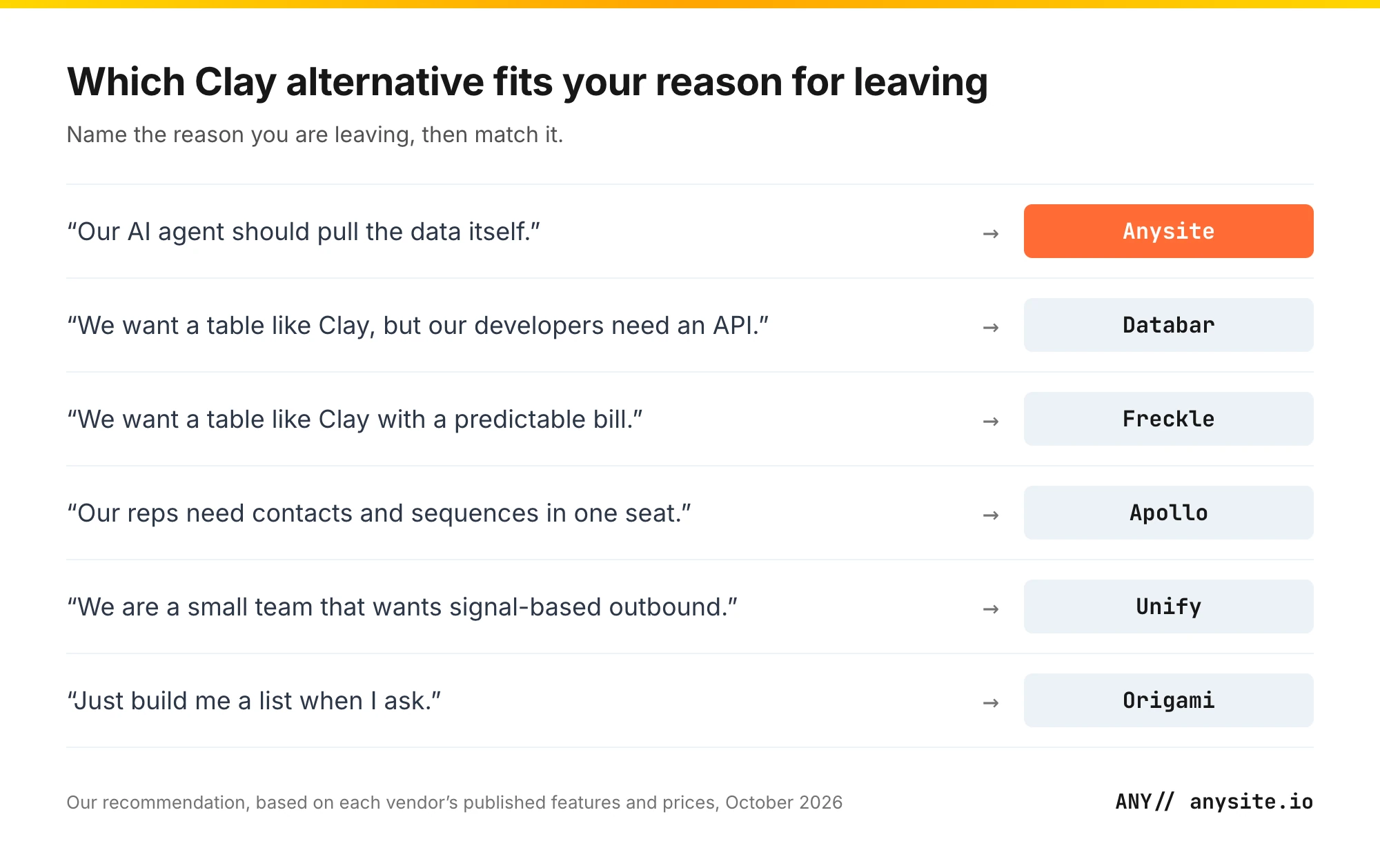
- "Our AI agent should pull the data itself." Anysite.
- "We want a table like Clay, but our developers need an API." Databar.
- "We want a table like Clay with a predictable bill." Freckle.
- "Our reps need contacts and sequences in one seat." Apollo.
- "We are a small team that wants signal-based outbound." Unify.
- "Just build me a list when I ask." Origami.
You may not need to leave at all. If your RevOps team designs plays visually, relies on waterfalls across many providers and shares tables across the company, Clay's Launch plan does that well for $185 a month. Staying is the right call when the workspace itself is what your team values, not just the data that comes out of it.
Frequently asked questions
What is the best Clay alternative?
It depends on who does the work. If an AI agent such as Claude, ChatGPT or Cursor runs your research, Anysite gives it live, typed data over MCP or API. If you want a spreadsheet like Clay with a simpler bill, look at Freckle or Databar. If you want data and sequencing in one seat-based tool, look at Apollo or Unify.
How much does Clay cost?
As of October 2026, Clay has a Free plan with 500 actions and 100 data credits a month. Launch costs $185 a month on monthly billing ($167 on annual), and Growth costs $495 a month ($446 on annual). Enterprise is custom and sold on an annual commitment.
Is there a free alternative to Clay?
As of October 2026, Freckle has a free forever plan with 250 credits, Apollo has a free plan with 900 credits per seat per year, and Unify has a free plan for up to 3 seats. Anysite has no free plan; it offers a 7-day free trial that needs a card to start.
Which Clay alternative is best for a small team?
As of October 2026, a solo founder who works through an AI agent can start on Anysite MCP at $30 a month, flat. A small sales team that wants a database plus sequences can start on Apollo Basic at $49 per seat per month billed annually, or Unify Base at $20 per seat per month.
How is Anysite different from Clay?
Clay is a table you build workflows in, with enrichment providers and AI columns. Anysite is a data layer your AI agent or code calls directly, returning typed records from 900+ sources and 5,000+ endpoints (anysite.io, October 2026). Clay is better if your team wants a visual workspace and built-in sequencing.
Keep reading
PhantomBuster alternatives
Lead data and web automation tools, from cloud automations to data layers your agent calls, compared on price and limits.
Apify alternatives
Options for teams that want live web data without managing a marketplace of actors.
Anysite MCP server
Connect Claude, Cursor or another MCP client to 900+ sources in a few minutes.
Try Anysite now
Give your AI agent live B2B people and company data, plus 900+ other sources, over MCP or API. 7-day free trial.
anysite.io