Crunchbase Company Data Is Now a First-Class API Endpoint
Crunchbase Company Data Is Now a First-Class API Endpoint
The AI Parser for Crunchbase worked. It returned useful data. But it was inconsistent in structure, slower than it needed to be, and missing the depth that makes Crunchbase valuable in the first place.
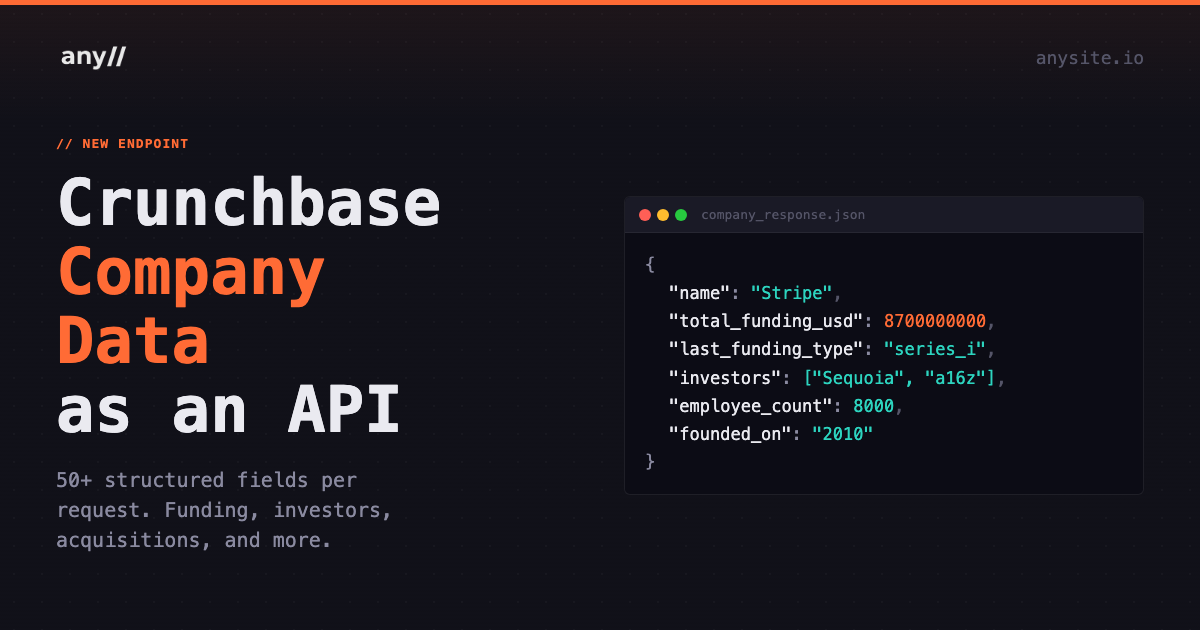
As of March 2026, Crunchbase has its own dedicated ready-made endpoint: POST /api/crunchbase/company. It returns 50+ structured fields in a consistent schema — funding history, investors, acquisitions, employee headcount, revenue range, patents, technology stack, offices, news, and more. Same single API call, richer data, predictable output every time.
What Changed
Before this release, Crunchbase data came through the AI Parser layer — a flexible system that can extract structured data from any URL, but one that's designed for breadth rather than depth. It works well for one-off lookups. It's not the right foundation for production pipelines that need reliable schema consistency.
The new endpoint is built the same way as Anysite's LinkedIn, Twitter, Instagram, and Reddit coverage: direct, structured, with a defined response schema you can depend on. You pass a company alias or a full Crunchbase URL. You get back a complete JSON object.
The input is straightforward:
curl -X POST "https://api.anysite.io/api/crunchbase/company" \
  -H "access-token: YOUR_TOKEN" \
  -H "Content-Type: application/json" \
  -d '{"company": "openai"}'
Both formats work as input:
- Company alias:
"openai","stripe","anthropic" - Full Crunchbase URL:
"https://www.crunchbase.com/organization/openai"
What the Response Contains
A single call returns data across seven broad categories. Here's a representative slice of the response for OpenAI:
{
  "id": "openai",
  "name": "OpenAI",
  "founded_on": "2015-12-11",
  "operating_status": "active",
  "ipo_status": "private",
  "num_employees_enum": "1001_5000",
  "revenue_range": "r_100000000",
  "funding_total": {
    "value": 11300000000,
    "currency": "USD"
  },
  "num_funding_rounds": 7,
  "last_funding_type": "secondary_market",
  "investor_count": 25,
  "categories": ["Artificial Intelligence", "Machine Learning"],
  "funding_rounds": [...],
  "investors": [...],
  "acquisitions": [...],
  "technologies": [...],
  "news": [...]
}
The full response covers:
| Category | Fields |
|---|---|
| Core identity | name, legal name, alias, website, founded date, operating status, company type, short description |
| Funding | total raised, number of rounds, last funding type, investor count, full round history with dates/amounts, lead investors per round |
| Investors | investor names, types, and participation history |
| People and scale | employee count range, revenue range, key hires, leadership |
| Corporate activity | acquisition history with targets and deal values, IPO status |
| Technology | detected technology stack, Siftery product data, Apptopia app metrics |
| Market signals | Bombora intent surges, news coverage, awards |
| Offices | headquarters and office locations |
| IP | patent filings |
Building Pipelines Around Company Data
The endpoint is built for programmatic use at scale. Here's a Python example that enriches a list of companies and outputs a funding summary:
import requests

API_KEY = "YOUR_TOKEN"
BASE_URL = "https://api.anysite.io"

def get_company_data(company_alias):
    response = requests.post(
        f"{BASE_URL}/api/crunchbase/company",
        headers={"access-token": API_KEY, "Content-Type": "application/json"},
        json={"company": company_alias}
    )
    response.raise_for_status()
    return response.json()

def summarize_funding(data):
    return {
        "name": data["name"],
        "founded": data.get("founded_on"),
        "total_raised_usd": data.get("funding_total", {}).get("value"),
        "rounds": data.get("num_funding_rounds", 0),
        "last_round": data.get("last_funding_type"),
        "revenue_range": data.get("revenue_range"),
        "employee_range": data.get("num_employees_enum"),
        "investors": [
            inv["name"]
            for inv in data.get("investors", [])[:5]
        ]
    }

companies = ["stripe", "notion", "linear", "vercel", "supabase"]

for alias in companies:
    data = get_company_data(alias)
    summary = summarize_funding(data)
    print(summary)
This kind of pipeline — pull company data, normalize it, load it into a database or feed it to an LLM — is where the structured schema matters. You're not parsing variable HTML. You're consuming typed JSON fields that mean the same thing across every response.
Who This Is For
CRM and sales teams enriching leads: If a prospect just raised a Series B, that's a buying signal. A pipeline that checks Crunchbase funding data against your CRM and flags recent raises lets your team prioritize outreach based on funding events, not guesswork.
# Check if a company raised in the last 90 days
from datetime import datetime, timedelta

def recently_funded(company_alias, days=90):
    data = get_company_data(company_alias)
    rounds = data.get("funding_rounds", [])
    if not rounds:
        return False
    latest = max(rounds, key=lambda r: r.get("announced_on", ""))
    announced = datetime.strptime(latest["announced_on"], "%Y-%m-%d")
    return announced >= datetime.now() - timedelta(days=days)
Investment analysts running due diligence pipelines: Filter a list of companies by funding stage, revenue range, and employee count before dedicating analyst time. The endpoint returns enough signal to triage at scale.
# Filter companies by stage and scale
def passes_screening(data, min_funding_rounds=2, target_revenue_range="r_10000000"):
    return (
        data.get("num_funding_rounds", 0) >= min_funding_rounds
        and data.get("revenue_range") == target_revenue_range
        and data.get("operating_status") == "active"
    )
AI agents that research companies before sales calls: An agent that receives a company name, pulls Crunchbase data, cross-references it with LinkedIn headcount and recent press, and delivers a pre-call brief removes an hour of manual research from every enterprise sales touchpoint.
Market mapping: Pull structured data on every company in a category — technology stack, funding history, revenue range, employee count — and you have the raw material for a market map that would take a team weeks to build manually.
Credits and Pricing
Each call to /api/crunchbase/company costs 20 credits. That's the same pricing tier as other data-intensive endpoints on the platform.
On the Growth plan (100K credits at $200/mo), that's 5,000 company lookups per month. On Scale (190K credits at $300/mo), it's 9,500. If you're running batch enrichment jobs, the PAYG top-up rate applies at $2.90 per 1K credits.
For one-off research or low-volume enrichment, the Starter plan (15K credits at $49/mo) covers 750 lookups — enough to enrich a mid-sized prospect list.
The Endpoint Reference
| Field | Value |
|---|---|
| Method | POST |
| Endpoint | /api/crunchbase/company |
| Parameter | company (alias or full URL) |
| Credits | 20 per request |
| Timeout | 20–1500 seconds (default 300) |
| Response | Structured JSON, 50+ fields |
Full field reference and response schema at docs.anysite.io/api-reference/crunchbase/crunchbasecompany.
Anysite provides pre-built endpoints for LinkedIn, Instagram, Twitter, Reddit, YouTube, Crunchbase, SEC EDGAR, Y Combinator, Google, and more. For any website not in that list, the AI Parser generates structured data on demand. More at docs.anysite.io.