Amazon EU price comparison via API: five storefronts, one query, an €11.19 spread
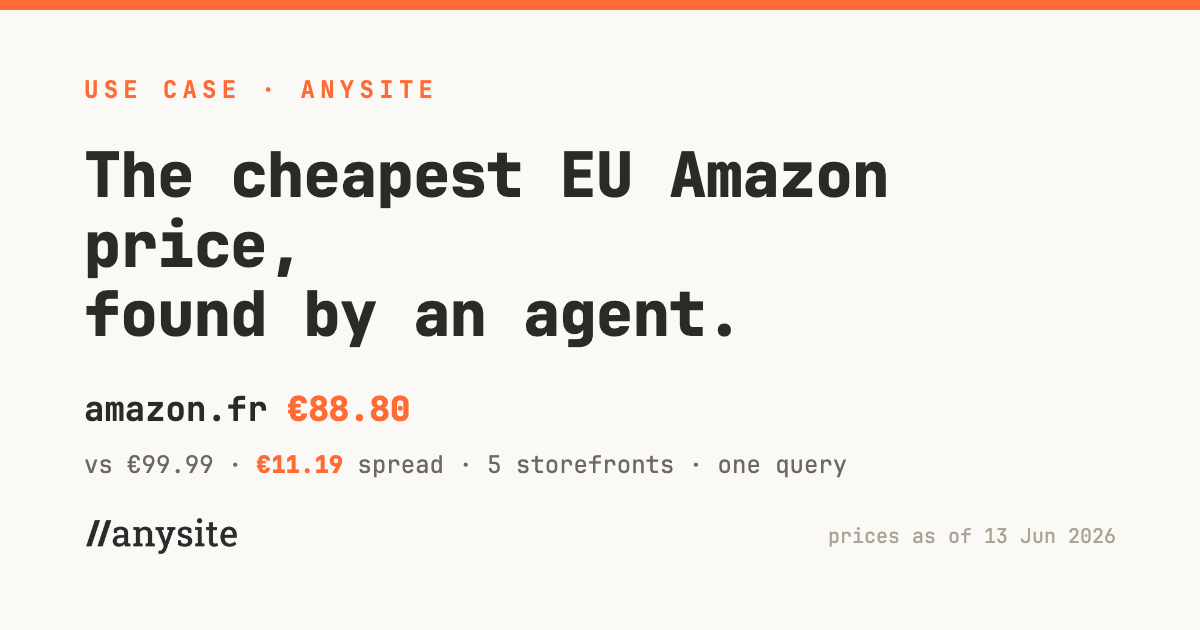
The Anysite Amazon price API retrieves live product prices from multiple Amazon national storefronts in a single structured workflow — returning amazon.fr, amazon.de, amazon.it, amazon.es, and amazon.nl prices as comparable rows without manual tab-switching. Agents and automation workflows use this pattern to surface cross-border price spreads at machine speed. A five-storefront comparison that takes 15 minutes of manual browsing runs in seconds as a few API calls.
This article walks through a live run against a real ASIN — the exact endpoints called, the raw results, and what the output means for agent workflows that monitor EU price spreads.
▶ Watch the agent run this live (49s) — one chat, the real calls, the result.
What does a real Amazon EU price comparison look like?
Product: Logitech MX Master 3S (2025), ASIN B0FHHV6YR5 (4.6★, 628 reviews). Run date: 13 June 2026.
Endpoints called:
amazon/products/products_search— find the product and lock the exact ASIN (one call, amazon.de).amazon/products/products_offers— the live New / sold-by-Amazon buy-box price for that ASIN, one call per storefront.
Results (New buy-box, as of 13 June 2026):
| Storefront | Price (EUR) |
|---|---|
| amazon.fr | 88.80 |
| amazon.de | 99.99 |
| amazon.it | 99.99 |
| amazon.es | 99.99 |
| amazon.nl | 99.99 |
Prices captured 13 June 2026; storefronts update independently and may drift within minutes.
Amazon.fr returned EUR 88.80 — about 11% below the other four EU storefronts on that date (EUR 11.19 / EUR 99.99), carrying a live promotion the others did not. The full result set exports to a single file, mx-master-3s-eu.csv.
This is the price difference a buyer closes by ordering from amazon.fr instead of any other EU storefront on that date.
Why buy-box, not catalog price?
The catalog list_price is a reference number — it lags promotions and can be days behind. The products_offers New / sold-by-Amazon buy-box is the price you actually pay at checkout, and it reflects live deals. On this run, amazon.fr was carrying a promotion the catalog price did not show. When the question is "what does it cost to buy this right now," the buy-box is the only honest answer — and it is the number every asset here uses.
Why do Amazon EU prices differ between countries?
Amazon operates independent national storefronts with separate seller pools, localized promotions, and country-specific VAT structures. A seller pricing on amazon.de is not required to match their price on amazon.fr.
The EU Omnibus Directive (Directive 2019/2161), via the amended Price Indication Directive 98/6/EC, requires traders announcing a price reduction to display the lowest price applied in the preceding 30 days — and this obligation operates per trader per national marketplace, not across EU storefronts. Directive 98/6/EC, Article 6a (as amended by Directive (EU) 2019/2161)
Cross-border price variation is consequently systematic and predictable — a function of seller pricing strategy and localized demand, not an anomaly. The EUR 11.19 spread on a EUR 99.99 product is real money, recoverable with one query.
How does the //anysite API run this comparison?
The workflow is four moves:
discoverconfirms what the source exposes — three Amazon product endpoints, across 19 marketplaces — so the agent plans before it spends a call.amazon/products/products_searchconfirms the product and returns one unambiguous ASIN (here, B0FHHV6YR5). Every storefront call then uses that same ASIN, which is what makes the comparison valid.amazon/products/products_offersfetches the live buy-box for that ASIN, once per storefront — five calls for five EU markets.- The agent-side join assembles the five rows into a ranked table and computes the spread. No server-side aggregation step is needed — the comparison is a client-side join on the ASIN, then an
export_datacall drops the whole set to a CSV.
The result set exports to one file — mx-master-3s-eu.csv (columns: asin, marketplace, price, currency, condition, sold_by).
This is the substrate-and-brain split in one run: Anysite returns each marketplace's live data; the agent does the fan-out, the ASIN join, the spread math, and the export.
What can you build with Amazon price spread data?
Agent workflows built on this pattern include:
- Price monitoring: run the five-storefront query on a schedule; alert when the cheapest storefront changes or the spread exceeds a threshold.
- Procurement routing: for B2B buyers sourcing hardware in bulk, identify the cheapest EU storefront programmatically before each purchase order — not after manual search.
- Market research: aggregate spread data across a product category to see which storefronts consistently undercut the others.
- Arbitrage detection: flag products where the cross-border spread exceeds the shipping cost, surfacing resale windows with a positive margin.
Each pattern runs the same structure. The difference is what the agent does with the ranked output.
One connection, hundreds of endpoints, any website on the web
Amazon is one source. Through the same five tools — discover, execute, get_page, query_cache, export_data — an agent reaches hundreds of endpoints across retail, finance, professional networks, and social platforms, plus any website on the open web. The interface never changes; only the question does.
The web wasn't built for AI agents. This is what it looks like when the data layer is.
Frequently asked questions
Which Amazon EU storefronts does this cover? The products_search and products_offers endpoints support amazon.fr, amazon.de, amazon.it, amazon.es, and amazon.nl. Amazon.co.uk is available via the same endpoints using the co.uk domain parameter — one of 19 supported marketplaces.
How current is the price data? Data is fetched live from each storefront at query time. Prices reflect the current buy-box winner at the moment of the call — not a cached or delayed snapshot.
Why is the buy-box price different from the listed catalog price? The catalog list_price is a reference value that lags promotions; the products_offers buy-box is the live, purchasable price including current deals. Use the buy-box for any "what does it cost now" question.
Does the export include seller information? The export contains asin, marketplace, price, currency, condition, and sold_by. Deeper seller identity can be added via an additional offers call per ASIN.
Docs: docs.anysite.io